Crypto Casino Network and Transaction Fees Explained
Crypto casino fees actually never come as a single cost and that is because they basically come from multiple places at the same time. On one hand, you have the most obvious one which is the blockchain network fee, and then on the other hand you have exchange withdrawal costs or platform withdrawal fees that come directly from the casino.

Our reviews are independent. We may earn a commission if you register with a casino through our links. This does not influence our ratings.
Reading time: ~ 9 minutes
Once you deposit or withdraw crypto from a certain casino you are actually interacting with a blockchain transaction, and this means that the fees will depend mainly on the underlying network as well as how the casino processes its payments internally.
There are three models of fees that are most commonly used among crypto casinos. For example, some of them do state that they are not charging additional fees and that the users will only pay a blockchain network fee. On the other hand, there are casinos that apply a withdrawal fee that’s fixed and deducted directly from a player’s balance. And then you have another type of fee which is a percentage based withdrawal fee.
So it’s really important for you to understand how these fees actually appear so you can rule out any inconveniences or confusions.
Where Fees Appear in Crypto Casino Transactions
These fees can appear during multiple different stages during a casino transaction. The first cost oftentimes appears once you make the very first deposit, and once you send crypto to a casino the blockchain TX requires a network fee that will be paid by the sender. And this fee actually goes to the miners and it is absolutely not controlled by the casino at all.
Then after that deposit arrives, the casino itself credits that balance on its internal ledger. It’s important to note that they are not blockchain transactions anymore, but they are just simply internal entities within the system of the casino itself. And because of that the movements between the internal balances can actually happen without any network fees at all.
Then another potential cost that can appear is when you convert some assets inside the casino. And once this happens the conversion price might include a small trading fee.
The last major cost is appearing when you want to withdraw. That’s because, once you do that, the casino itself has to broadcast a new blockchain transaction and this transaction requires a network fee. And depending on their internal policy, the casino can either charge you a fixed withdrawal fee or simply apply a percentage charge.
Blockchain Network Fees
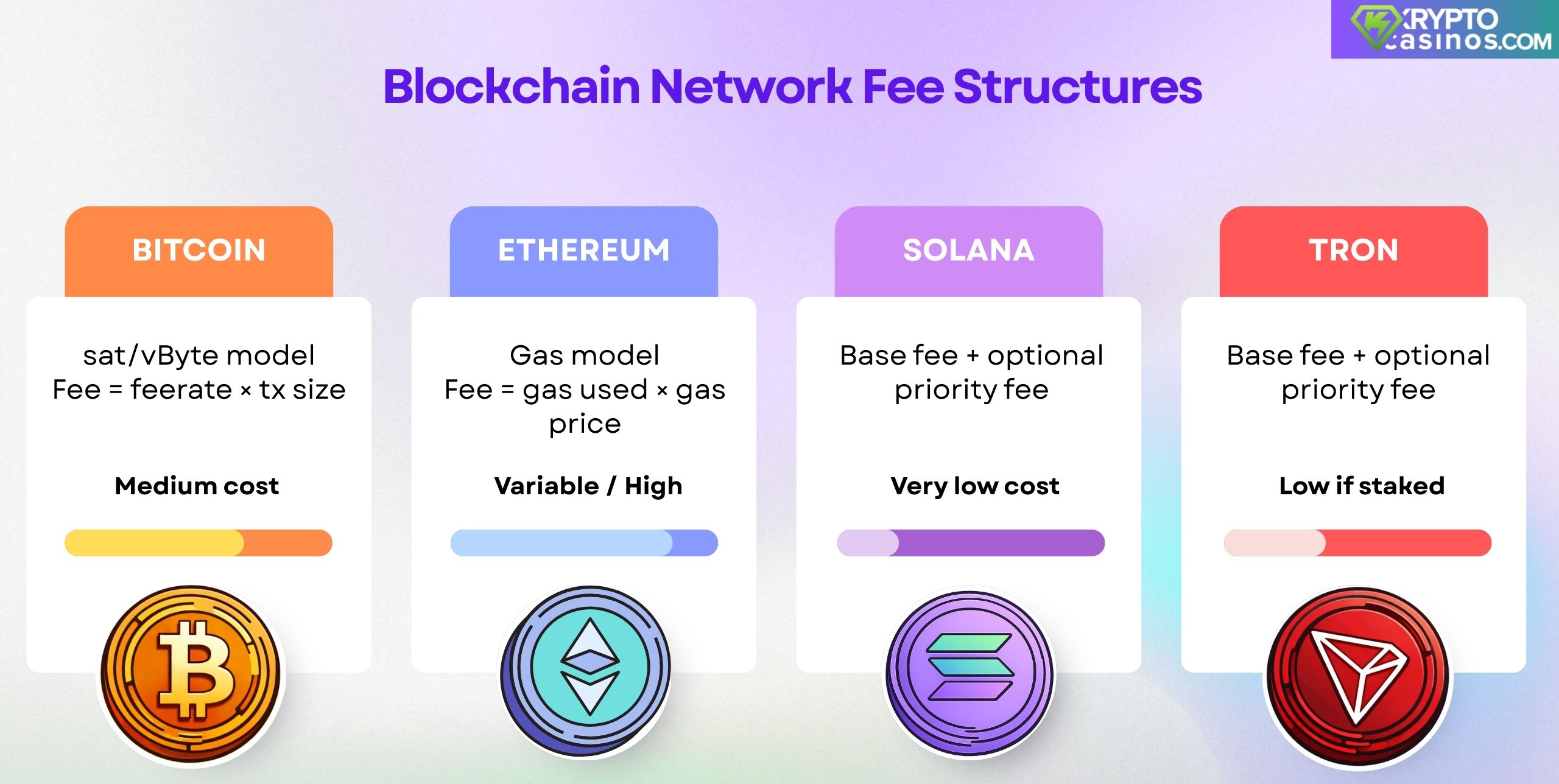
The inevitable cost is definitely coming from the blockchain itself. For example, BTC transactions are using a fee rate that is measured in satoshis per virtual bite and the final fee in this case, is going to depend on the actual size of the transaction itself + the fee rate that’s needed for faster confirmation.
On the other hand you have Ethereum and other EVM networks that use a different model – that’s the gas model. Every single action basically requires a certain amount of gas and the final transaction here equals the gas used then multiplied by the gas price at that exact given moment.
Next, we have Solana which uses a slightly different structure. It is charging a small base transaction fee + an optional fee that you can pay if you want to speed up the confirmation.
Then again, we have another network that works differently – the Tron network. Here, instead of gas, it uses a resource model that’s based either on Bandwidth or Energy. For example, if your account doesn’t have enough of these resources TRX is burned automatically in order to cover the transaction cost.
ERC-20 vs TRC-20 Mechanics for USDT Fees
It is oftentimes very confusing for players that the same token can basically exist on many blockchain networks, and USDT is a great example of this.
So, ERC-20 USDT is running on the Ethereum network and if practically follows the gas system. Here, every transfer requires gas that’s paid in ETH even though the crypto that’s being transferred is USDT. And since ERC-20 transfers are interacting with a smart contract they oftentimes use more gas than simple Ethereum transfers.
On the other hand there is TRC-20 USDT which runs on the Tron blockchain and it follows Tron’s model. As we already discussed, the transactions here consume Bandwidth or Energy and if the sender has enough resources then the transfer can cost very little, but if not, TRX is burned automatically in order to pay for the required resources.
In this case, the cheaper transfers are definitely the TRC-20 USDT transfers; however the exact cost will totally depend on the network conditions and the availability of resources.
For you as a casino player, it’s important to note that the network definitely matters more than the token symbol itself. And sending USDT on ETH and sending USDT on Tron are different transactions with entirely different fee structures.
Internal Transfers and Vault Systems
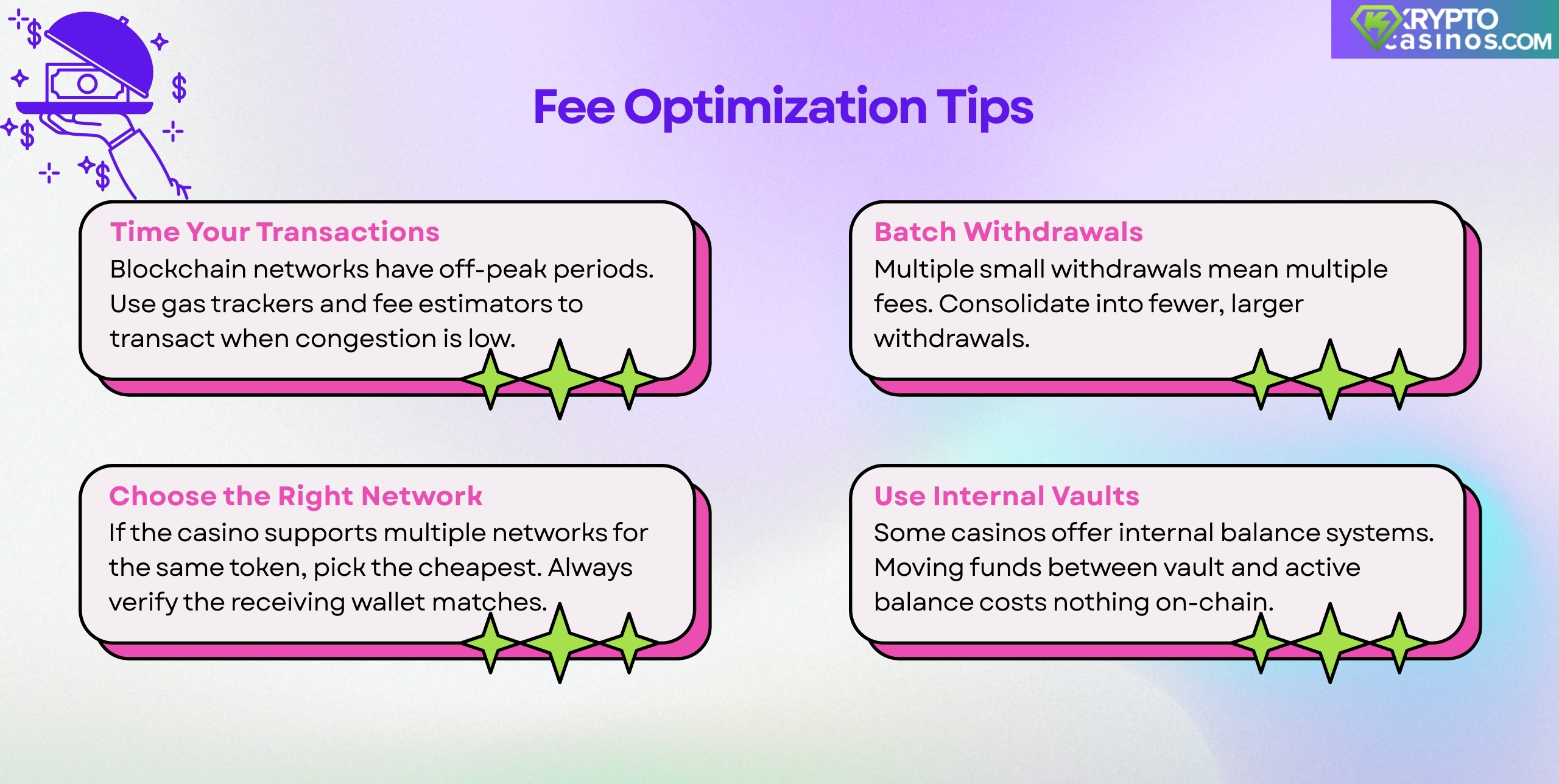
There are some crypto casinos in the market that include internal wallet systems that are created to reduce these withdrawal costs. So they are allowing players to actually move the funds between an active balance as well as an internal vault without triggering any blockchain transaction. Once this movement happens within the casino’s ledger no network fee is required.
So the main idea behind these systems is to basically reduce the amount of these on chain transactions. Instead of withdrawing the funds after every session, casino players can keep their balance stored internally and only withdraw when necessary. It’s also important for you not to keep any big amounts in the casino itself.
Here, it’s important to note that this can indeed reduce the transaction costs, however the funds will remain under the control of the casino platform itself.
Network Fee Examples
Understanding how these network fees are calculated helps explain why withdrawal costs can vary so much between transactions. Below, we present you a table that will help you understand these fees much better.
| Example scenario | Inputs | Fee Calculation | Estimated cost | Notes |
|---|---|---|---|---|
| BTC SegWit transfer (casino withdrawal example) | Mempool fee: 1–2 sat/vB. BTC price: $67,656. Casino withdrawal fee: 0.00001571 BTC. | Assume 140 vB transaction. Fee = feerate × size. Fast: 2×140 = 280 sat. Medium: 1×140 = 140 sat. | Network: 0.00000140–0.00000280 BTC (~$0.09–$0.19). Casino fee example: 0.00001571 BTC (~$1.06). | Transaction size is estimated. Casino withdrawal fees may include batching or internal processing costs. |
| ERC-20 USDT withdrawal (Ethereum) | Gas price: 0.04 gwei. ERC-20 transfer ≈ 65,000 gas. ETH price: $2,003.62. | Fee = gas_used × gas_price. 65,000 × 0.04 gwei = 0.0000026 ETH. | ≈ 0.0000026 ETH (~$0.005). | Ethereum fees fluctuate heavily depending on network congestion. |
| TRC-20 USDT transfer on Tron | Resource usage example: 64,285 Energy + 345 Bandwidth. TRX price: $0.287. | Energy cost ≈ 6.4285 TRX. Bandwidth ≈ 0.345 TRX. Total ≈ 6.77 TRX. | ≈ $1.84–$1.94. | Fees can drop significantly if TRX is staked for Energy/Bandwidth. |
Practical Fee Optimisation in Crypto Casinos
Crypto casino players oftentimes try to reduce the transaction fees even though the options are somehow limited by the network the casino itself supports.
Timing the transactions can definitely help reduce the costs because the blockchain networks can experience periods of congestion as well as quiet periods. There are fee estimation tools as well as gas trackers that can help identify the times when transaction fees are likely to be lower.
What also matters is the withdrawal frequency. For example, multiple small withdrawals can basically result in higher total fees compared to just fewer larger withdrawals simply because each withdrawal can trigger a separate blockchain transaction.
There are also some casinos that set minimum withdrawal limits that can make withdrawing very small amounts less cost efficient.
What’s also important here is choosing the right network. If the casino of your choice is supporting several networks for the same token, selecting a cheaper network can basically significantly reduce the costs. Anyways, the network that you will use has to always match the casino’s supported network as well as the receiving wallet.
Compliance and Operational Factors
The transaction fees are actually not the only factor that’s affecting the crypto withdrawals. There are some casinos that are actually requiring from you to perform an identity check before you withdraw. These procedures themselves can actually delay the process, and you should keep that in mind.
What can also affect the withdrawal process are global AML regulations and compliance procedures. And because of these operational requirements the withdrawal process can take some time.
Global anti-money-laundering regulations and compliance procedures can also influence how withdrawals are processed and how quickly funds are released.
Security Risks and Hidden Costs
Perhaps the biggest financial risk in these crypto transactions is oftentimes not really the visible network fee but the mistakes that are actually related to the network compatibility.
As discussed previously, many different types of cryptocurrencies exist on multiple networks. And sending the correct token but on the wrong network might result in your funds being permanently lost or extremely difficult to recover. This issue is more common with stablecoins such as USDT which exists on several different blockchains.
The good news is that casinos will usually warn that deposits that are sent through unsupported networks can’t be really credited and are not recoverable.
Then, there is another hidden cost that can appear when the withdrawal fees are only shown during the very final step of the process. There are some platforms that are very transparent and show their detailed fee schedules in advance while others display that fee only once you request a withdrawal. And because of this, the final withdrawal cost is not always visible until you request the withdrawal. To avoid unexpected costs and other withdrawal issues, you can follow the steps explained in our guide on how to withdraw safely from a crypto casino.
Conclusion
So we can definitely conclude that the crypto casino transaction fees are a combination of blockchain costs + casino platform policies, and that the largest unavoidable cost comes from the blockchain network fees.
So these fees would totally depend on the specific network that is being used and can vary depending on the transaction demand as well as the network conditions.
For players the most important factors affecting costs are network selection, withdrawal frequency, and making sure that transactions are sent through the correct blockchain network. Once these mechanics are understood, it becomes much easier to avoid unnecessary fees and costly mistakes when moving funds in and out of crypto casinos.
We have imposed strict editorial guidelines on ourselves and explain our testing methods openly and comprehensively. We also communicate transparently how our work is financed. This site may contain tracking links, but this does not influence our objective view in any way.
Sources
- Stake. "Acceptable Blockchain Networks for Cryptocurrencies". Accessed on 09.03.2026. https://help.stake.com/en/articles/7980790-acceptable-blockchain-networks-for-cryptocurrencies.
- Ethereum. "Network Fees". Accessed on 09.03.2026. https://ethereum.org/gas/.
- Solana. "Fees". Accessed on 09.03.2026. https://solana.com/docs/core/fees.
- Kraken. "Cryptocurrency withdrawal fees and minimums". Accessed on 09.03.2026. https://support.kraken.com/articles/360000767986-cryptocurrency-withdrawal-fees-and-minimums.