Can You Sue a Crypto Casino? What You Need to Know
Suing a crypto casino is totally possible in some certain cases, but it is not always that simple.
If you are reading this guide, it means that you were already in a situation where some particular casino has ignored your complaints, refused to pay you or maybe didn’t really resolve the issue after you have reported it.

Our reviews are independent. We may earn a commission if you register with a casino through our links. This does not influence our ratings.
Reading time: ~ 6 minutes
In this guide, we are going to focus more on legal options that you can take, rather than withdrawal delays or routine disputes. You will find out information about when it is actually realistic to take a legal action, what limits usually apply and why some of the cases fail before they even reach a courtroom.
Understanding these constraints helps you decide whether pursuing legal action makes sense – or whether other forms of pressure are going to be more effective.
Before You Consider Legal Action
Before jumping into legal action, it’s important to pause for a moment. Not every payout issue turns into a legal case, and many disputes are still part of the normal (even if frustrating) process.
If you’re still trying to figure out whether a payout delay is legitimate, see what to do when a crypto casino won’t pay out first.
Start With the Casino’s Dispute Process
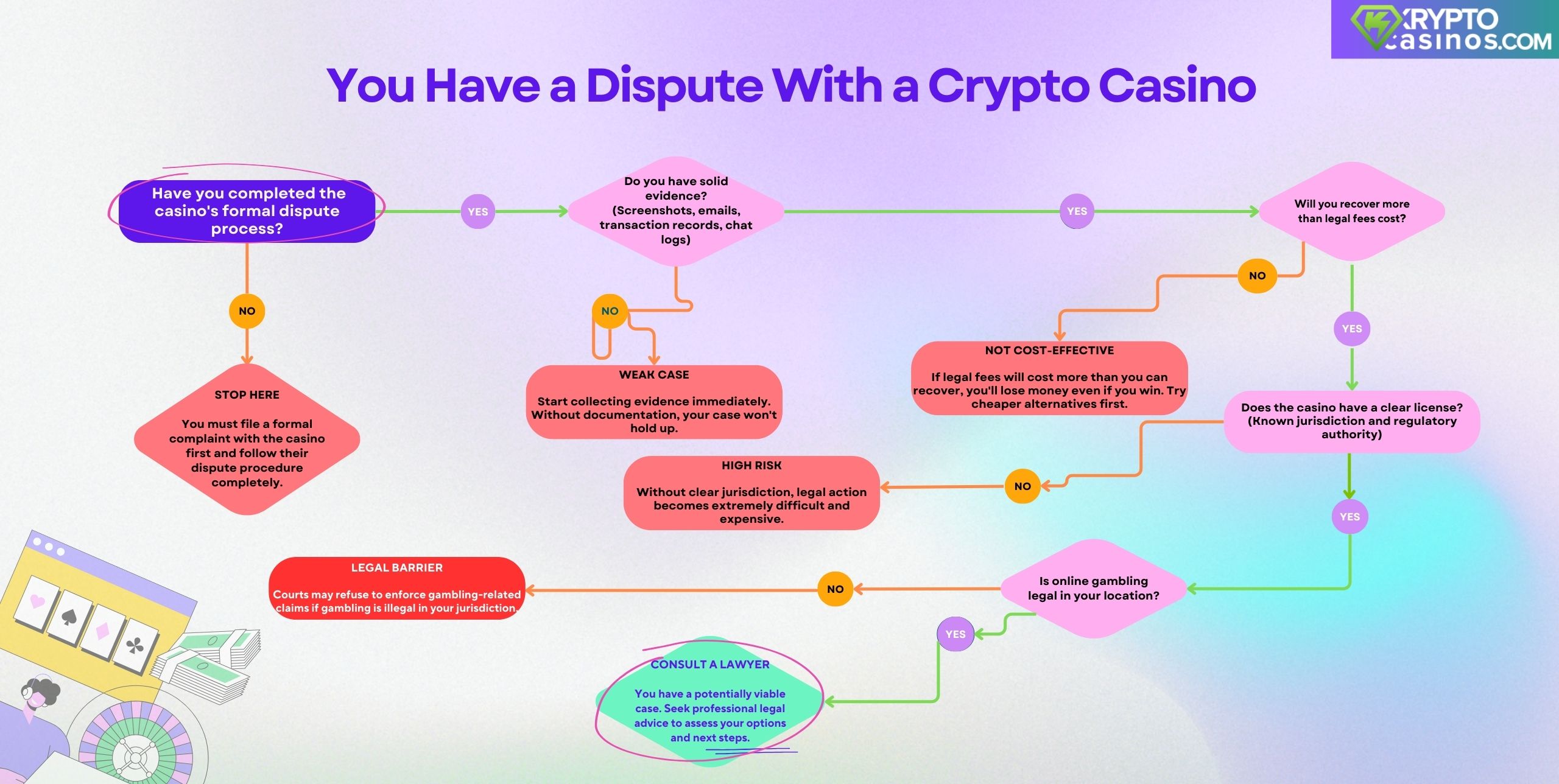
This part right here would definitely feel frustrating especially if you were already ignored, however it is necessary for you to do this. Before you step into any legal action, it is important for you to show that you totally tried to solve the issue directly with that specific casino. It could mean submitting a formal complaint, contacting customer service and following their dispute procedure step by step.
As said earlier, this step matters a lot, no matter how pointless it might feel. That’s because if you ever speak to a layer, they will be asking you whether you already tried to resolve the issue properly.
Collect Everything That Proves Your Case
This is the moment when screenshots suddenly become very important. Keep records of deposits, withdrawals, balances, chat conversations, emails, and even timestamps. It sounds obvious, but many people only start collecting evidence after the situation gets serious, which makes things harder.
Having a clear timeline of what happened often makes the difference between a strong case and a weak one.
Check the Licence and Jurisdiction
This part can feel confusing, but it is crucial. Some crypto casinos operate with licences, others operate in grey areas, and some operate without meaningful oversight at all. The location of the licence usually decides where disputes are handled and what rights you might have.
If the casino has no clear licence or hides its ownership, legal action becomes much harder from the start.
Think About the Cost and Effort
Legal action takes time, money, and patience. If the disputed amount is small, the process may simply not be worth it. This is one of the uncomfortable realities of legal disputes, but it is better to be realistic early on.
When Legal Action Becomes Relevant
Legal action usually becomes realistic only after everything else has failed. If the casino clearly owes you money and keeps refusing to pay despite formal complaints and dispute procedures, the situation starts to move into legal territory.
Large unpaid winnings are the most common trigger. Another common situation is when the casino’s own terms say you are entitled to the money, yet they still refuse to pay. If the casino is licensed, this can make legal action slightly more realistic because there is at least a legal framework behind the business.
Still, legal action is rarely the first step. It is more like the final step after you have tried everything else.
Can You Sue a Crypto Casino?
Yes, in theory you can. A crypto casino is still a business and you agree to a contract when you accept the terms and conditions. If that contract is broken or fraud is involved, legal action becomes possible.
The problem is that the practical side is complicated. Many crypto casinos operate offshore and include clauses saying that disputes must be handled in foreign courts. This means you may have to deal with legal systems in other countries, which can quickly become expensive and complicated.
Another issue is the legality of gambling in your own jurisdiction. In some places, courts may refuse to enforce gambling-related claims at all. Even if you win a case, enforcing the judgment can be difficult if the casino has no assets in your country or operates mainly through cryptocurrency.
So yes, suing is possible, but it is rarely straightforward.
Where Crypto Casino Lawsuits Usually Fail
Most lawsuits never even start because of jurisdiction problems. Offshore companies, unclear ownership, and cross-border operations make it difficult to decide where the case should even be filed.
Another common issue is weak or non-existent regulation. Without strong oversight, there may be no effective authority to support your complaint. In some jurisdictions, courts may refuse to enforce gambling debts entirely.
Crypto payments add another layer of difficulty. Unlike bank transfers or card payments, crypto transactions are irreversible. That removes many of the financial protections people normally rely on.
All of this means that even strong cases can become complicated very quickly.
Legal Paths That Sometimes Work Better Than Suing
Complaints to Regulators
If the casino has a licence, contacting the regulator can sometimes create real pressure. Regulators may not recover your money directly, but they can investigate or sanction operators.
Reporting Fraud and Consumer Complaints
In some situations, the dispute may go beyond gambling and move into fraud territory. Reporting the case to consumer protection agencies or cybercrime units can trigger investigations and build a record against the operator.
Public Pressure and Dispute Platforms
This might sound surprising, but public complaints can sometimes be more effective than legal action. Forums, complaint platforms, and review sites create visibility. Casinos often react faster when their reputation is at risk.
When to Talk to a Lawyer
Speaking to a lawyer becomes realistic when you have tried everything else and the amount involved is significant. A legal professional can help you understand whether your case has a real chance and where it should be filed.
They can also explain the risks, costs, and possible outcomes so you can decide whether it is worth moving forward.
Conclusion
Suing a crypto casino is not impossible, but it is rarely simple. Many disputes never reach court because of jurisdiction issues, enforcement challenges, and the global nature of crypto gambling.
In many cases, pressure through complaints, regulators, and public reporting turns out to be more effective than a lawsuit. If those steps fail and the case is strong enough, legal advice can help you decide whether taking the next step makes sense.
We have imposed strict editorial guidelines on ourselves and explain our testing methods openly and comprehensively. We also communicate transparently how our work is financed. This site may contain tracking links, but this does not influence our objective view in any way.
Sources
- Gambling Commission. "How to complain". Accessed on 09.02.2026. https://www.gamblingcommission.gov.uk/public-and-players/guide/page/how-to-complain.
- Consumer Financial Protection Bureau. "Submit a complaint about a financial product or service". Accessed on 09.02.2026. https://www.consumerfinance.gov/complaint/.
- Malta Gaming Authority. "Lodge a Complaint". Accessed on 09.02.2026. https://www.mga.org.mt/player-hub/lodge-a-complaint/.