Why Stablecoins Are Popular at Crypto Casinos
Stablecoins in simple terms are cryptocurrencies designed to stay pegged to a traditional currency like the US dollar or euro. And this honestly matters more at crypto casinos than most people would expect, simply because they solve one of the biggest headaches with regular crypto: the constant price swinging.

Our reviews are independent. We may earn a commission if you register with a casino through our links. This does not influence our ratings.
Reading time: ~ 7 minutes

In a traditional online casino your balance is either in euros or dollars which are fairly stable during a session, whereas in crypto casinos the value of your balance might change even when you stop actually playing. You can finish a session with the exact same amount of Bitcoin you started with and you can still be up or down depending on how the market behaved.
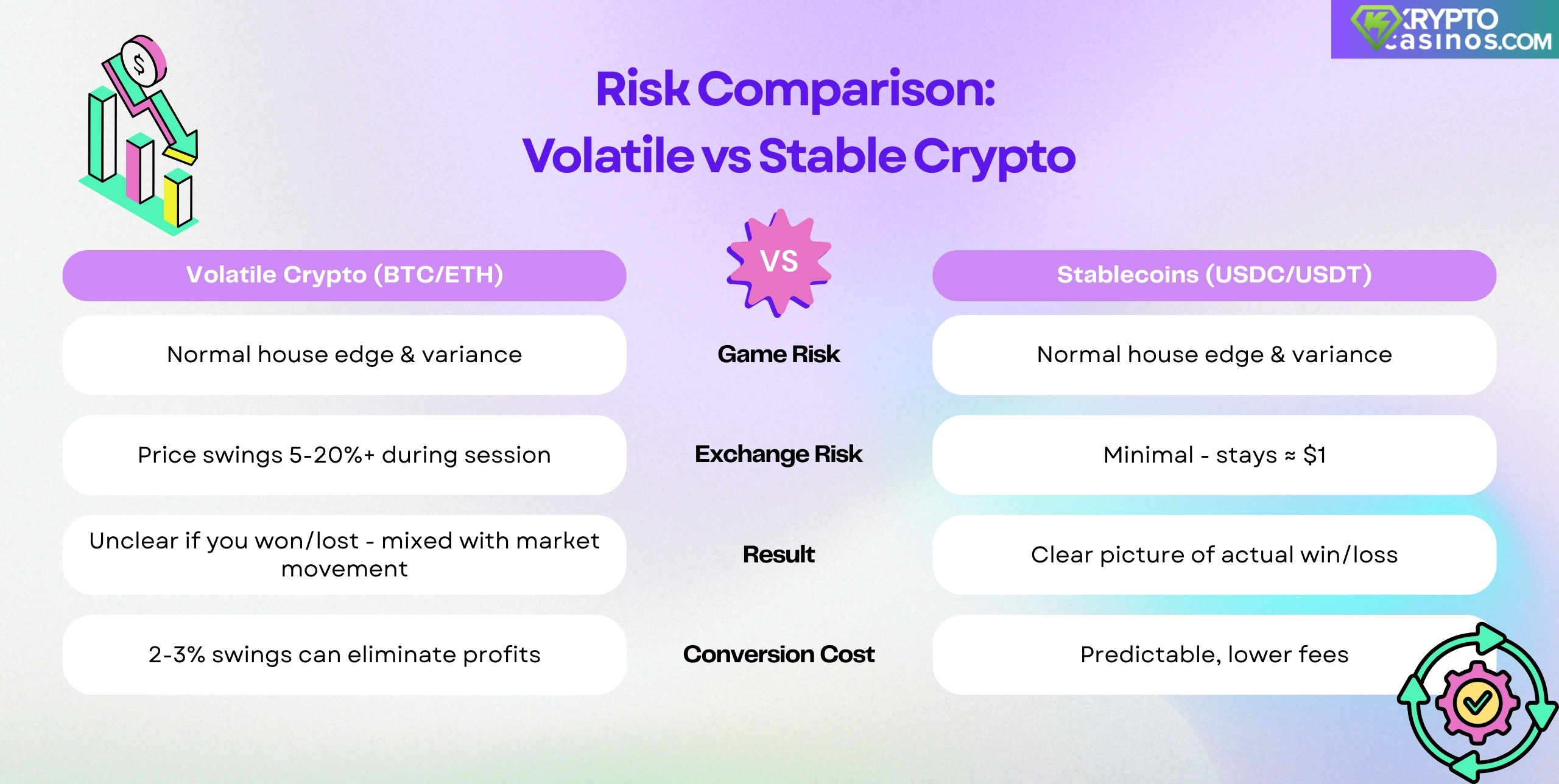
And in this case that crypto casino risk can actually come from two places. The first one would be the actual normal casino risk like house edge and game variance. The second risk is the exchange rate risk – and that’s the price of the coin simply moving up or down during your play.
Oftentimes it’s the second part that ends up being the bigger factor. And just because the crypto market has moved, a session that might feel neutral in crypto terms can turn into a noticeable loss or gain. This is where stablecoins actually help reduce the uncertainty, without eliminating it entirely.
What Stablecoins Actually Do in Practice
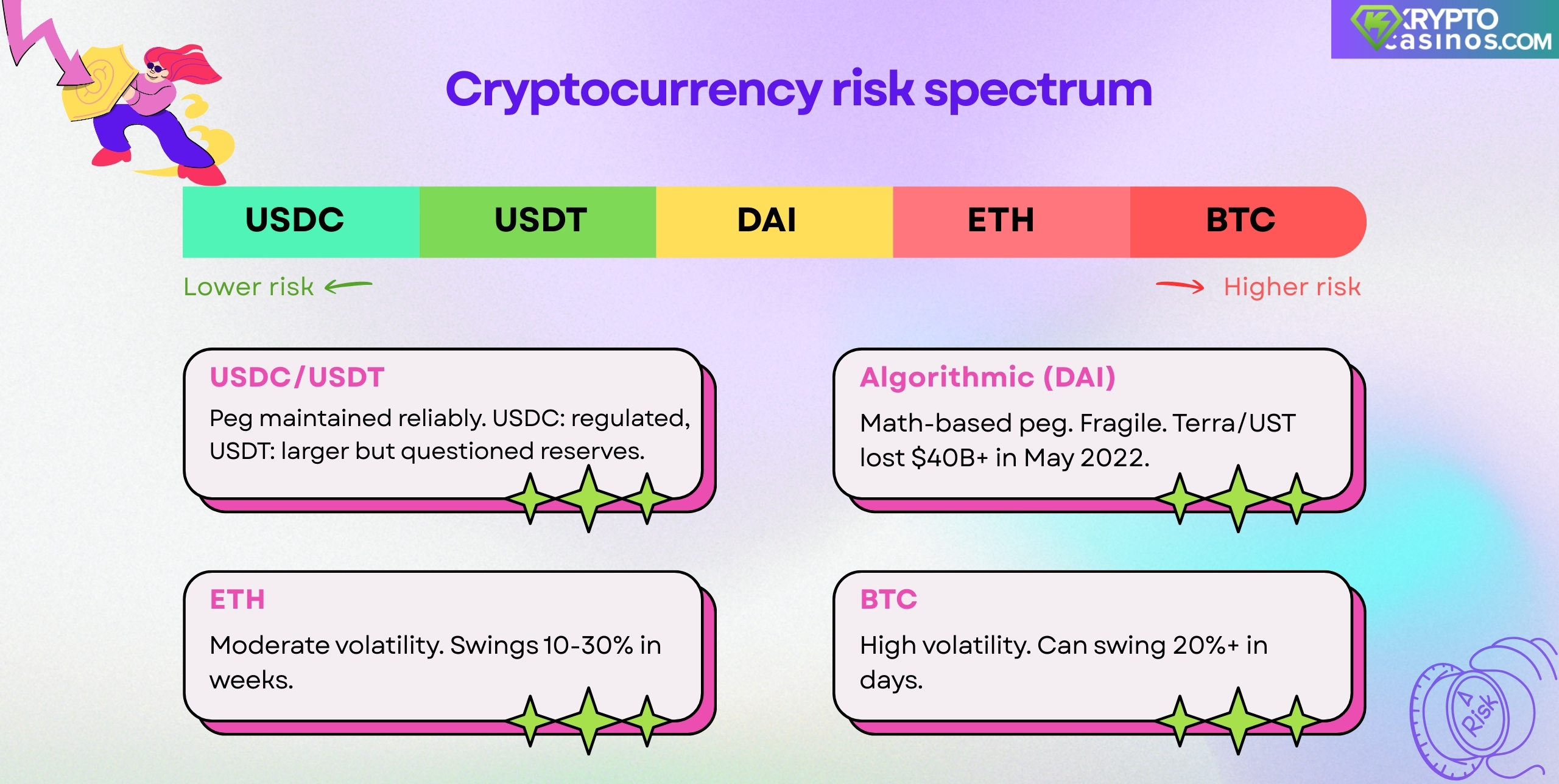
Stablecoins work by maintaining a peg to traditional currencies. The most common ones are USDT (Tether), USDC (Circle), and DAI. And they do work through in different ways; this means that USDT is basically backed by the reserves that Tether actually holds, while USDC is issued by a company that is regulated and audited very regularly. On the other hand we have DAI which is created algorithmically through smart contracts. That means that a stable coin is simply designed to stay worth roughly the same value from day to day.
Now let us take a closer look and see how this works in practice. For instance, if you deposit €200 worth of USDC that amount will basically remain worth €200 no matter whether you play or not. In this case the price will not move 10 or 20% overnight just because the broader crypto market did. This actually makes budgeting much much easier because a €200 session is going to stay close to €200 in value instead of going much more way up or down with the market itself. And honestly more experienced players would go ahead and prefer this option because they reduce the size of price swings.
There is also an additional benefit, and that’s converting it back to euros. So once you feel ready to cash out you can convert your USDC directly to euros at whatever the market rate is at that exact given moment. And your conversion costs are much more lower and way more predictable because you’ll be converting between 2 assets which are designed to track similar values.
Stablecoins Reduce Swings But Do Not Remove Risk
Here’s the important thing to note – stablecoins reduce risk but they don’t eliminate it. The term “stable” can be quite misleading. The peg can sometimes shift for a while, and some coins have even failed before.
The most infamous example is Terra’s UST, which completely collapsed in May 2022. This algorithmic stablecoin lost its dollar peg and plummeted from $1 to under 70 cents before eventually falling below 12 cents. The collapse erased over $40 billion in market capitalization and wiped out $400 billion in broader cryptocurrency losses – one of the largest financial collapses in crypto history.
The Terra collapse revealed how fragile algorithmic stablecoins can be. UST relied on complex mathematical formulas and a sister token (LUNA) to maintain its peg, rather than actual asset reserves. When market conditions deteriorated and investors panicked, the system failed catastrophically. The Foundation tried deploying $480 million in Bitcoin reserves to defend the peg-it didn’t work.
USDT has faced persistent doubts about reserve backing over the years. USDC had a brief depeg during the March 2023 Silicon Valley Bank crisis, falling to $0.88 before recovering. While these major stablecoins recovered relatively quickly, they demonstrated that even the largest, most established stablecoins can temporarily lose their peg under stress.
There is also platform risk and wallet risk just like with any other cryptocurrency. Your stablecoin is only as safe as the wallet and exchange you’re holding it in. Using a reputable exchange like Kraken or Coinbase matters. Leaving money on an obscure casino wallet for months is riskier than keeping it somewhere regulated.
Because crypto transactions are irreversible, wallet security becomes extremely important. If funds are stolen, the recovery options are limited, which is why it helps to know what to do if a crypto wallet is hacked.
Anyways, even with those certain risks, stablecoins remain the simplest way to reduce volatility exposure if your goal is towards predictable spending rather than only speculation.
How Stablecoins Help with Emotional Spending
One of the less obvious problems with volatile crypto is psychological. When a coin drops in price, players often deposit more just to bring their balance back to the same value in euros. It can feel like you are topping up after a losing session, even if you did not actually lose anything in the games. Sometimes the balance only looks smaller because the coin price changed.
This is where stablecoins actually help. Because a USDC balance that drops from €500 to €480 tells you exactly what happened – you lost €20 in actual play. You’re not wondering whether the market moved against you or if your strategy was wrong. The distinction becomes clear.
What helps with emotional reactions is setting certain limits. And for that, the most important approach is deciding your session budget in fiat before depositing, no matter what happens with prices. There are some players that also follow the no topups rule during a session and this honestly removes the temptation to react to the price movements emotionally.
When you’re playing in euros or USDC, the psychological pressure is much lower. A session that was always meant to be €50 stays €50 whether the markets moved or not. You’re not fooling yourself about how much you actually spent.
Deposits, Withdrawals, and Conversions
It’s quite obvious but even basic tracking helps. Knowing the deposit price and withdrawal price makes it easier to understand what actually happened during a session. And without that information it’s easy to confuse market movement with gambling results.
Both deposits and withdrawals involve conversions and they can often determine the actual outcome of a session much more than the games themselves. The price differences between the moment you deposit and the moment you decide to withdraw can drastically affect the results. With Bitcoin or Ethereum, a 2-3% price swing during conversion can wipe out your edge entirely.
With stablecoins, those conversion costs are much lower and more predictable. Some players prefer to set up price targets when converting instead of accepting whatever the price is available at that exact moment. On the other hand, others might convert gradually instead of doing everything in only one transaction. Either approach works as long as the rules are clear from the start.
The key point is this: if you’re using volatile crypto, the deposit and withdrawal prices matter enormously. If you’re using stablecoins, they matter much less. That’s a meaningful difference over time.
Deposits and withdrawals also involve blockchain network costs, which vary depending on the chain used. Our guide on crypto casino network and transaction fees explains how these costs appear during transfers.
Stablecoins Don’t Change the House Edge
No matter which coin you use, stablecoins don’t change the mathematics of the game. That means that RTP and house edge will remain the same. A game with 96% RTP will still return the same percentage in crypto terms, whether it’s Bitcoin or USDC. The only thing that changes is how clearly you can track what’s actually happening.
And this is why stablecoins can sometimes feel a bit confusing – a player might technically win at the tables but still finish with less money if Bitcoin has dropped enough. Managing the volatility is definitely about controlling this additional layer of uncertainty.
Takeaway
Crypto casinos include a second type of risk that doesn’t exist in traditional online casinos. Besides the normal game variance there is also an exchange risk from the coin itself. Most of the time these risks can be reduced with simple habits – thinking in fiat terms, setting your session budget beforehand, and controlling your conversions.
What makes this process much easier is stablecoins. However, they can also involve their own risks – the peg can break, platforms can fail. The important thing to understand is that crypto price movement is separate from the gambling results. Once you fully understand that distinction, managing volatility becomes much simpler and easier.
If you want to reduce the volatility exposure, USDC and USDT are the practical choices. They won’t eliminate risk, but they make it much clearer what’s actually happening during your session.
We have imposed strict editorial guidelines on ourselves and explain our testing methods openly and comprehensively. We also communicate transparently how our work is financed. This site may contain tracking links, but this does not influence our objective view in any way.
Sources
- Next.io. "Stablecoins and gambling: How MiCA regulations impact crypto casino operations". Accessed on 03.03.2026. https://next.io/news/promoted/how-mica-regulations-impact-crypto-casino-operations/.
- CCN. "Stablecoin Market Booms but Regulatory Concerns Remain". Accessed on 03.03.2026. https://www.ccn.com/news/crypto/stablecoin-market-booms-regulatory-concerns-remain/.
- International Monetary Fund. "Understanding Stablecoins". Accessed on 03.03.2026. https://www.imf.org/-/media/files/publications/dp/2025/english/usea.pdf.