How to Deposit Safely at a Crypto Casino
Depositing at a crypto casino is quite different from depositing at a traditional online casino with a credit card because, most of the time what you are actually doing is sending a blockchain transaction. And that means that you are basically transferring crypto from a wallet that you can control or sometimes directly from an exchange account.

 Advertising transparency
 The casino reviews and recommendations on Kryptocasinos.com are independent and transparent. This helps users worldwide make well-informed decisions when choosing the right online crypto casino.
To this end, we research current casino data, process it objectively, and offer users interactive features such as filters and comparison tables. This allows readers to conduct their own research free of charge, compare our content and the casinos, and make their own decisions on this basis.
We may generate revenue when readers register at one of the casinos.
We have imposed strict editorial guidelines on ourselves and explain our testing methods openly and comprehensively. We also communicate transparently how our work is financed. This site may contain tracking links, but this does not influence our objective view in any way.
Reading time: ~ 8 minutes
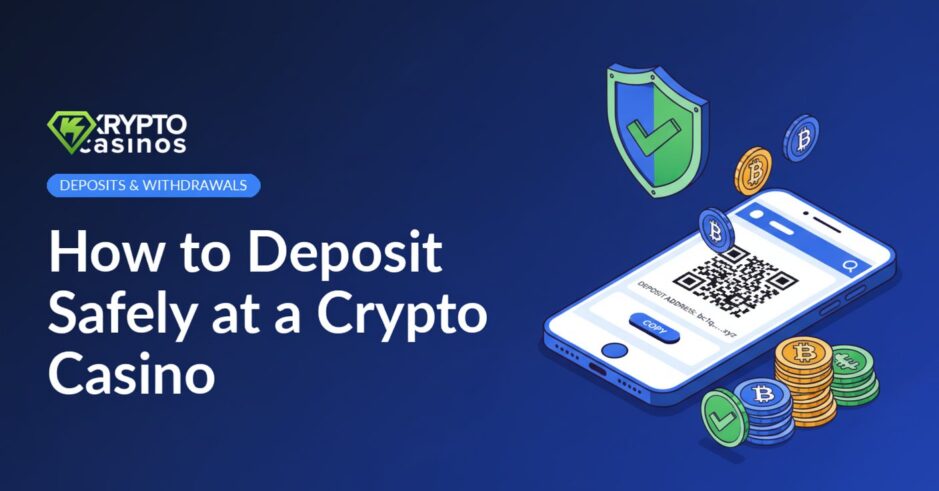
It is important to remember that once that transaction is confirmed to the blockchain it is not possible to revert it in general. That’s because there is not a chargeback system like you have with credit cards. If for some reason the funds are sent to the wrong address or network, it’s basically impossible to recover them unless the recipient itself voluntarily sends them back.
So that is why depositing safely at crypto casinos comes down to avoiding some common problems. Firstly, you must make sure that you are not sending funds to the wrong address or token or network. On the other hand, you can lose control of your wallet or casino account due to phishing, and then the third possibility is running into withdrawal issues once you have already deposited.
So in practice, most of the deposit problems fall into one of the above mentioned categories which is why safe depositing comes down to three things: you need to pick a reliable platform, you’ll need to send the transactions carefully and finally keep your accounts safe.
How Crypto Casino Deposits Work?
There are a lot of moving parts behind the crypto deposit process, more than people even think.
So once you click the deposit button at a crypto casino, the platform actually generates a blockchain address that is actually linked to your account. And then, once you send some funds to that address and the transaction is confirmed on the blockchain, the casino credits the amount to your balance.
And yes this sounds very simple but there are important details that you need to take into account. For example, there is crypto volatility, transaction fees as well as the security of the funds once they are held by the operator.
Let’s see how that works in practice.
What a Deposit Address Actually Is
A deposit address is a public blockchain address. When you send crypto to it, the transaction is recorded on the blockchain.
Then the casinos link that address internally to your personal account so they actually know where those funds should be credited.
It is also very important to note that in some regulated environments, the wallet addresses can basically become a part of the verification process. There are some certain systems that require the casinos to confirm it is actually you that are controlling the wallet that is used for the deposits. And that can actually involve a small test transaction or some other form of verification of your wallet.
Confirmations and Finality
What’s important to know about deposits is that they are usually not credited immediately because the casinos wait for confirmations. These are actually additional blocks that are added to the blockchain after the block that contains your transaction.
So the purpose of this? It is practically to reduce the risk of double spending or blockchain reorganizations. For example, let’s look at Bitcoin where transactions are considered as secure after 6 confirmations. And since BTC blocks appear every 10 minutes, that actually means that you’ll need to wait around 1 hour before the deposit is considered final.
Some other blockchains actually work a little bit differently however the basic idea remains the same. And the more confirmations a transaction receives, the harder it is to reverse it.
Custody Changes the Risk Model
One other thing that’s actually very easy to overlook is that the risk profile changes the moment the deposit is credited.
So before you send the funds the coins are actually totally secured by your own wallet security practices. And after the deposit the casino or the payment processor becomes the actual custodian.
So the main concern shifts here and the bigger one is worrying about the operator and if it’s actually secure later on when it comes to withdrawal.
And there have been several incidents connected to this. Last year, in February 2025, around $1.5B was stolen from Bybet, a crypto exchange in a hack by North Korean cyber hackers. And events like this can definitely cause withdrawal delays or some other disruptors even at large crypto platforms.
Risks and Challenges Players Face
There are a few ways crypto deposits can realistically go wrong. Most of them come from the simple fact that blockchain transactions cannot be reversed.
Sending Mistakes That Cannot Be Reversed
Probably the most common issue is simply sending funds incorrectly.
If cryptocurrency is sent to the wrong address, the transaction cannot be cancelled once it’s confirmed. Exchanges and wallet providers repeat this warning constantly because people still make this mistake.
Another common problem involves sending funds on the wrong network. For example a casino might accept USDT deposits only on the TRON network, while a player accidentally sends USDT on Ethereum instead.
Depending on the custody setup those funds might not be recoverable.
Some networks also require additional routing information such as memos or tags. If those are missing the deposit might not be credited properly and sometimes cannot be recovered.
Address Poisoning Scams
One threat that has become more common recently is something called address poisoning.
The idea is fairly simple. Attackers generate wallet addresses that look very similar to legitimate ones. Then they send small transactions to a victim’s wallet so those addresses appear in the wallet's transaction history.
Later the victim copies one of those addresses when sending funds and accidentally transfers the deposit to the attacker.
And yes, this has already caused some very large losses.
In May 2024 a victim sent about $68 million in wrapped Bitcoin to an attacker after relying only on the first and last characters of the address rather than checking the full string.
Blockchain analytics company Chainalysis investigated the broader campaign behind this and identified 82,031 addresses used to poison transaction histories. In total 2,774 victims sent roughly $69.7 million to scam-related wallets.
Research suggests the scale may be even larger. A 2025 study measuring address poisoning across Ethereum and Binance Smart Chain observed hundreds of millions of attack attempts targeting tens of millions of wallets and documented at least $83.8 million in confirmed losses.
Wallet Compromise and Phishing
Deposit safety also depends heavily on the security of the wallet or exchange account used to send funds.
Phishing attacks, malware, and credential theft are still some of the most common ways attackers steal crypto. If someone gains access to your wallet or casino account, they can redirect withdrawals or drain funds quickly.
Because of that, cybersecurity authorities consistently recommend strong passwords and two-factor authentication for financial accounts. For higher-value accounts physical security keys are often considered one of the strongest protections against phishing attacks.
Compliance Freezes and Withdrawal Issues
Even when deposits arrive correctly, access to funds can still become restricted if compliance checks fail.
Many regulated gambling environments require identity verification shortly after the first deposit. If a player does not complete verification within the required timeframe, accounts may be blocked and withdrawals restricted.
Some systems also require proof that the player controls the wallet used for deposits. If ownership cannot be verified, funds may be temporarily frozen while the situation is reviewed.
Volatility and Timing Risk
Another factor people sometimes forget about is timing.
Crypto prices can move significantly between the moment you buy coins, the moment you send them, and the moment the casino credits the deposit.
Network congestion can also cause delays. Transactions with low fees might remain pending for longer if the blockchain becomes busy.
How Operators and Regulators Manage Deposit Risk
Casinos that operate in regulated environments usually follow strict procedures when accepting crypto deposits.
Financial authorities often treat cryptocurrency payments as higher risk because of potential links to fraud or money laundering. Because of that operators must implement identity checks, transaction monitoring, and anti-money-laundering controls.
International standards such as the FATF Travel Rule require crypto service providers to collect and transmit identifying information about both the sender and the recipient of transfers.
For players this usually translates into additional verification steps, deposit reviews, or occasional withdrawal delays when monitoring systems flag a transaction.
Practical Strategies Players Use to Deposit Safely
In practice many experienced players treat crypto deposits similarly to irreversible bank transfers.
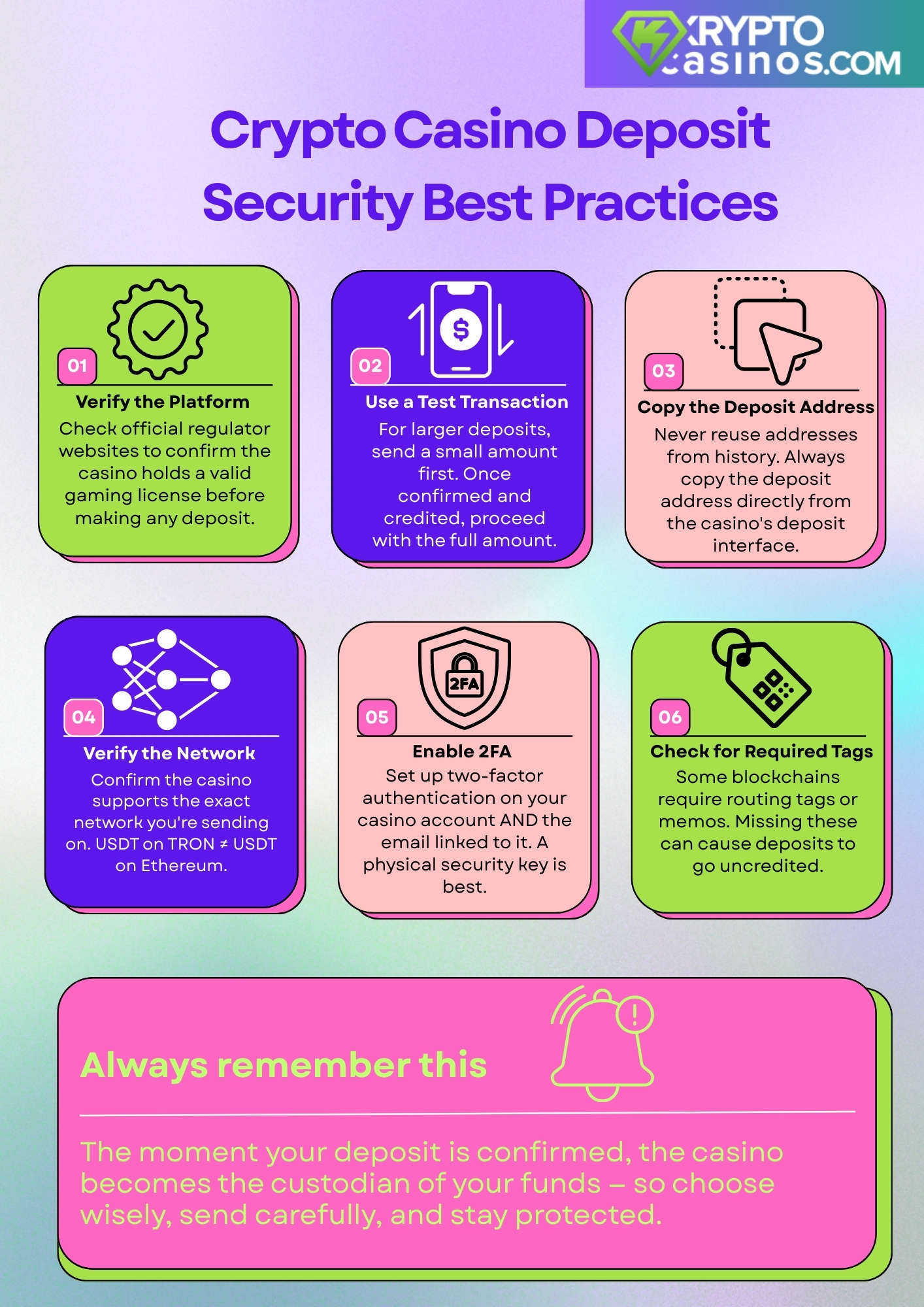
Verify the Platform
Before depositing, it’s good to check if the casino is legitimate and properly licensed, and some regulators have public lists where you can verify if a casino is legally licensed.
Use Test Transactions
For larger deposits many players send a small test transaction first. Once that arrives successfully, the remaining funds can be sent with more confidence.
Copy Addresses Directly
Because of address poisoning scams it is safer to copy deposit addresses directly from the casino interface each time rather than relying on addresses from previous transactions.
Verify the Network
Stablecoins like USDT exist on several different blockchains. Always confirm which network the casino supports before sending funds. Using the correct token on the wrong network is one of the most common causes of lost deposits.
Protect Your Accounts
Email accounts should be treated as the first security layer because password resets often rely on email access. Using password managers and two-factor authentication significantly reduces the risk of account takeovers.
Conclusion
Depositing at a crypto casino is not essentially complicated, however it does demand more attention compared to a traditional online casino for one simple reason and that is, as we said, that transactions are final. The thing is, there is no dispute process or chargeback. Also, in most cases there is no way to recover the funds in case they were sent to the wrong address. However, the main risks are very much avoidable and they can take just a couple of minutes.
You’ll definitely need to check the platform before you deposit as well as double check the deposit address and network every time. Test transactions are always a good idea as well as securing your account with 2FA. That will eliminate most of the issues that players are encountering.
What also matters besides the technical side is to actually remember that the relationship with your funds changes the moment a deposit is confirmed. That’s because the operator becomes the custodian which is why you have to choose a licensed and reputable casino platform.
Disclaimer: This website is for informational purposes only and does not constitute legal advice. Winnings are not guaranteed. Gambling can be addictive. Only play where legal in your region and check your local laws. Please gamble responsibly. | 18+
Sources
- Gambling Commission. "Blockchain technology and crypto-assets". Accessed on 06.03.2026. https://www.gamblingcommission.gov.uk/licensees-and-businesses/guide/page/blockchain-technology-and-crypto-assets.
- Binance. "How to Recover Crypto Transferred to the Wrong Network on Binance". Accessed on 06.03.2026. https://www.binance.com/en/academy/articles/how-to-recover-crypto-transferred-to-the-wrong-network-on-binance.
- Elliptic. "Wallet & Transaction Screening for AML Compliance". Accessed on 06.03.2026. https://www.elliptic.co/solutions/screening.