
How Long Do Crypto Withdrawals Take at Crypto Casinos?
Crypto casino withdrawals are often marketed as instant, but real payout times are often different than most players expect. Some arrive in minutes, while some take hours, despite using the same coin. Here we discuss what actually influences the speed of your withdrawals and where delays usually happen. Plus show realistic withdrawal times across the most used cryptocurrencies.

 Advertising transparency
 The casino reviews and recommendations on Kryptocasinos.com are independent and transparent. This helps users worldwide make well-informed decisions when choosing the right online crypto casino.
To this end, we research current casino data, process it objectively, and offer users interactive features such as filters and comparison tables. This allows readers to conduct their own research free of charge, compare our content and the casinos, and make their own decisions on this basis.
We may generate revenue when readers register at one of the casinos.
We have imposed strict editorial guidelines on ourselves and explain our testing methods openly and comprehensively. We also communicate transparently how our work is financed. This site may contain tracking links, but this does not influence our objective view in any way.
Reading time: ~ 6 minutes
Crypto withdrawals at online casinos are often described as instant. In practice, the withdrawal process requires more than one step, and each step affects the total payout time.
A crypto withdrawal typically consists of two parts. The first takes place within the casino system. The second occurs on the blockchain network.
The Two Parts of Crypto Withdrawals
The two parts work in sequence, not in parallel. The crypto withdrawal must first be cleared by the crypto casino before it can be sent to the blockchain for confirmation.
1. Casino Processing
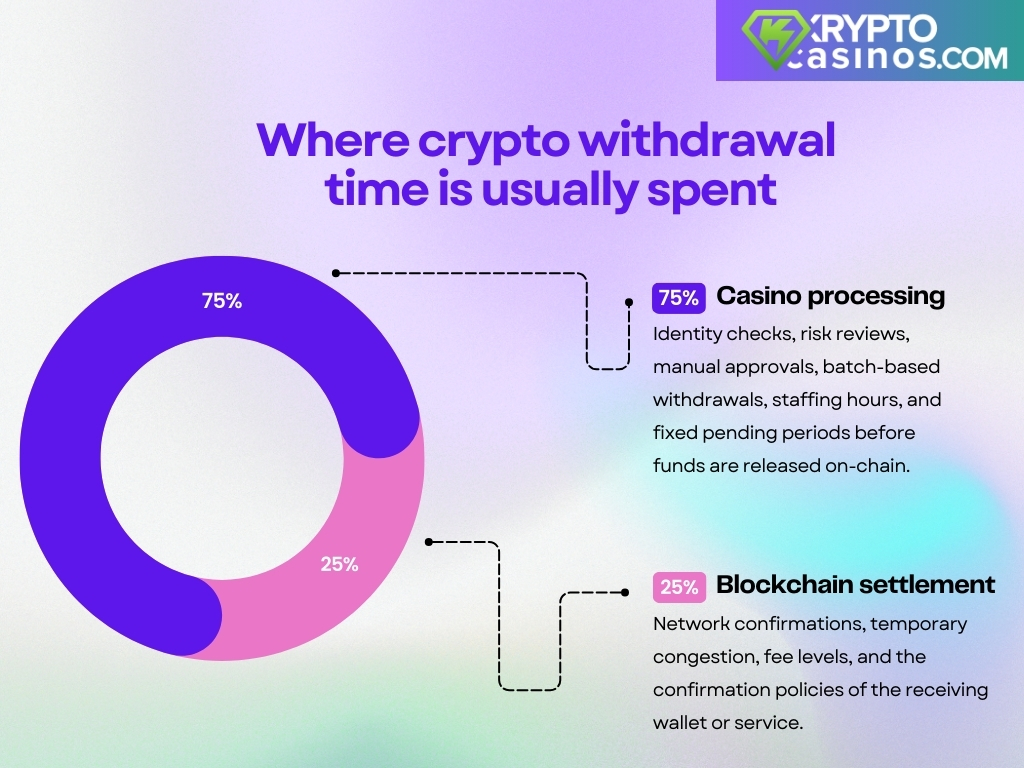
Casino processing begins once a withdrawal request is submitted. During this stage, the funds remain pending inside the casino before being sent to the blockchain.
Processing times vary between casinos and can range from a few minutes to several days. Delays are usually caused by internal procedures rather than the blockchain itself. Common reasons include:
- KYC or additional verification
Verification checks are often required during a first withdrawal, after larger winnings, or when account activity needs to be reviewed. If identity documents are requested, processing may take multiple days. - Manual review procedures
Some casinos rely on internal reviews related to risk management or fraud prevention, which can slow down withdrawals. - Batch-based withdrawal systems
Certain casinos process withdrawals at fixed intervals instead of continuously. As a result, requests may remain pending even when the blockchain network is fast. - Defined pending periods
Some casinos apply a fixed waiting period, commonly 24 to 48 hours, before releasing funds. These periods are usually outlined in the terms and conditions.
If you want to understand why withdrawals sometimes end up pending or get reviewed, you can read our page on crypto casino withdrawal issues and delays.
2. Blockchain Confirmation
Blockchain confirmation starts after the casino broadcasts the transaction to the network. This stage refers to the time required for the transaction to be verified and confirmed on-chain.
Confirmation speed depends on the blockchain used, current network congestion, and transaction fees. For most major cryptocurrencies, confirmation is completed within minutes.
In most cases, blockchain confirmation is faster than casino processing. The primary source of delay usually occurs before the transaction is sent to the blockchain.
Useful baselines:
- Bitcoin average block time ~10 minutes
- Ethereum average block time ~12-15 seconds
- Litecoin average block time ~2.5 minutes
- XRP Ledger closes ledgers about every 3-5 seconds
- Tron average block interval ~3 seconds
Confirmations matter most for BTC. Many services commonly use something like 3-6 confirmations.
Typical Real-World Ranges by Coin
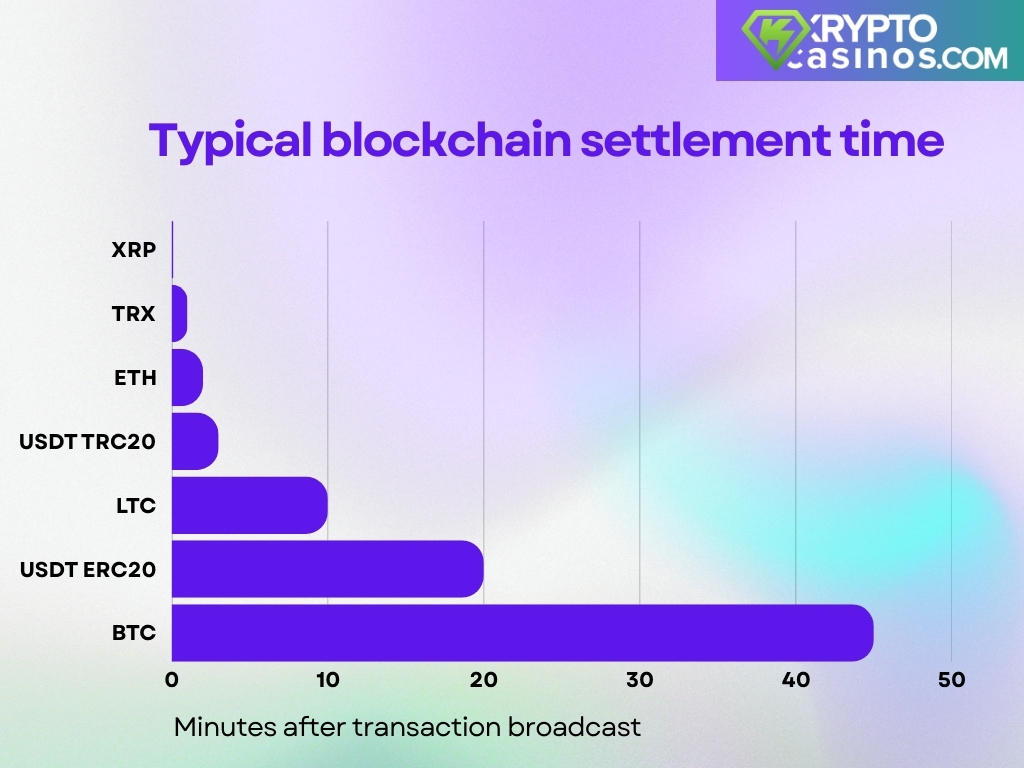
The table below assumes the casino has already approved the payout. It shows network settlement expectations, and what usually happens once you add processing time.
| Coin (typical network) | Network settlement after broadcast | “Real” payout range including casino processing |
|---|---|---|
| BTC (Bitcoin) | Often 30-60 min if 3-6 confirmations are required | 1 hour to 24+ hours (processing dominates when there is review or batching) |
| LTC (Litecoin) | Often ~5-20 min in practice (2.5 min blocks, fewer confirmations needed by many services) | 15 min to a few hours (again, depends on pending time) |
| ETH (Ethereum) | Can be minutes, but varies with congestion and fees | 10 min to several hours (ETH itself is quick, but “pending” is the swing factor) |
| USDT (TRC20 on Tron) | Commonly 1-5 min, can stretch during congestion | 5-60 min when casinos approve fast; hours if held in review |
| USDT (ERC20 on Ethereum) | Often 5-30 min, can go longer when gas is high | 30 min to several hours |
| USDC (Ethereum or Tron variants) | Ethereum-based transfers can be minutes; Tron variants are typically faster | 10 min to a few hours (same processing caveat) |
| XRP (XRP Ledger) | ~3-5 seconds ledger close time, near-instant settlement | 5-30 min if casino processing is fast; longer if flagged for checks |
| TRX (Tron) | ~3 seconds block interval | minutes to hours, mostly driven by processing |
For fast networks like XRP and Tron, the blockchain itself is rarely the limiting factor. In most cases, delays are caused by the casino’s internal withdrawal processing rather than the chain.
Advertised vs User-Reported Withdrawal Times
Withdrawal timing frequently varies from what casinos advertise. Operators typically present payouts under ideal circumstances. Players recount their experiences when withdrawals undergo standard checks and queues.
What casinos typically promote?
Most claims of “instant” withdrawals pertain to how swiftly a withdrawal can be authorized when no checks are initiated. Some casinos expedite fund releases. Others impose restrictions like maximum timeframes or pending periods that can be easily missed.
What users generally report?
User feedback usually divides into two main categories.
Quick payouts
These are often noted with USDT withdrawals on quicker networks. In these instances, users frequently observe funds arriving soon after approval.
Withdrawals delayed in pending
These reports arise when a withdrawal remains under review for a prolonged duration and no on-chain transaction has occurred yet.
The trend is evident. When there is no transaction hash, the delay occurs before the blockchain is engaged.
Examples of How Payouts Typically Function:
Example 1: USDT on Tron
- 12:00 Withdrawal request made
- 12:03 Approved, often automatically
- 12:04 Transaction dispatched
- 12:06 Funds received
This scenario occurs when there are no obstacles. The network operates smoothly, and the approval process is efficient. Tron effectively settles almost immediately after the transaction is dispatched.
Example 2: Bitcoin with a standard confirmation setup
- Withdrawal request at 12:00
- 12:20 Approved and dispatched
- 12:30 Initial confirmation received
- 1:00 to 1:20 The wallet or service requires a sufficient number of confirmations to process the credit
When all goes as planned, Bitcoin does not often provide an instant experience. The delay is due to the need for confirmations, rather than the casino's acceptance of the transaction.
Example 3: “Instant” as advertised, but not in practice
- Withdrawal requested
- Status remains pending for several days
- Subsequently, the transaction only appears
Why the Same Coin Can Take Minutes One Day and Hours the Next?
To better understand why withdrawal times vary even when using the same cryptocurrency, it is necessary to look at the factors that influence how withdrawals are processed.
Crypto casino payouts do not follow a fixed timeline, as several variables affect how quickly funds are released and confirmed.
First withdrawal versus repeat withdrawal
First-time withdrawals are more likely to trigger identity verification or additional checks. Repeat withdrawals often move faster once an account has an established history.
Network selection for stablecoins
Stablecoins such as USDT and USDC operate across multiple networks. Choosing a faster network like TRC20 can result in shorter transfer times, while ERC20 transfers may take longer during periods of high fees or network congestion.
Confirmation policies
Receiving wallets and services set their own confirmation requirements. This is especially relevant for Bitcoin, where higher confirmation thresholds introduce predictable delays.
Batching and staffing
A casino may process transactions quickly on-chain but still experience slower payouts if withdrawals are approved in batches or only during certain operating hours.
How to Measure Withdrawal Speed?
If you want clean and comparable data across casinos and coins of your own choice, you need track these:
A) Withdrawal requested time – from your account history
B) Approval – broadcast time when a TXID appears
C) First confirmation time on a block explorer
D) “Funds available” time in your wallet or service
Then calculate:
- Processing time = B − A
- Chain settlement time = C − B
- Total withdrawal time = D − A
In a Nutshell
For most of the coins, the blockchain part is usually just a couple of minutes, or for BTC under an hour. The actual experience of withdrawing funds in the real world is primarily determined by the casino's processing regulations, verification procedures, and waiting lines.
Disclaimer: This website is for informational purposes only and does not constitute legal advice. Winnings are not guaranteed. Gambling can be addictive. Only play where legal in your region and check your local laws. Please gamble responsibly. | 18+
Sources
- CoinGecko. "XRP Price: XRP Live Price Chart, Market Cap & News Today". Accessed on 27.01.2026. https://www.coingecko.com/en/coins/xrp.
- Baltex. "How Long Does Litecoin Take to Send? Transaction Times Explained". Accessed on 27.01.2026. https://baltex.io/de/blog/ecosystem/how-long-does-litecoin-take-to-send-transaction-times-explained.
- Bidget. "How Long Does XRP Take to Transfer". Accessed on 27.01.2026. https://www.bitget.com/wiki/how-long-does-xrp-take-to-transfer.