Common Crypto Casino Payment Mistakes And How to Avoid Them
One thing about crypto casino payments is that actually one mistake can cost you money that you can hardly get back. In an ordinary bank transfer, there is a possibility for you to dispute it or reverse it or even call someone. On the other hand, for blockchain transactions, it is known that they’re irreversible.

 Advertising transparency
 The casino reviews and recommendations on Kryptocasinos.com are independent and transparent. This helps users worldwide make well-informed decisions when choosing the right online crypto casino.
To this end, we research current casino data, process it objectively, and offer users interactive features such as filters and comparison tables. This allows readers to conduct their own research free of charge, compare our content and the casinos, and make their own decisions on this basis.
We may generate revenue when readers register at one of the casinos.
We have imposed strict editorial guidelines on ourselves and explain our testing methods openly and comprehensively. We also communicate transparently how our work is financed. This site may contain tracking links, but this does not influence our objective view in any way.
Reading time: ~ 9 minutes
So once your money leaves it is practically gone. If for some reason your account gets hacked or you fall under a phishing attack, it’s very much unlikely to reverse that transfer. And honestly, this changes everything you need to know about moving your money around crypto casinos.
A lot of players worldwide get really attracted to crypto casinos because of the privacy and the speed; however most of them ignore the fact of what might go wrong on the payment side of things. And that’s where most of the problems begin. However, the good news is that once you know what to look for, all of these mistakes are totally preventable.
Not Enabling Two-Factor Authentication
Skipping two-factor authentication is probably the most common mistake players make, and honestly it's also one of the easiest to fix. A lot of players don't enable 2FA and this leaves their accounts wide open if someone phishes their password. And since crypto transactions can't be reversed, if someone steals your funds that way, you basically have no way to get them back.
Here's the practical problem: your password by itself just isn't enough. If someone phishes your login details, they can get into your account and move your money immediately. But a 2FA layer means even if they have your password they still can't access the account without something else, usually your phone.
It’s important to note that most of the reputable crypto casinos have and support 2FA methods. There are authentication apps like Google Authenticator, SMS verification or even hardware keys. And in this case the authentication apps are basically stronger than SMS. So in order to make sure that your safety is guaranteed, make sure to enable 2FA right after you’ve created your account and before you deposit anything really.
From there, every time you log in or make a withdrawal you would need to unlock and add additional factors. Anyways, that’s a feature not a bug; because it forces you to actually stay present with your account instead of just clicking through mindlessly.
The trade-off here is convenience. You'll need to unlock an additional factor every time you log in or make a withdrawal. But honestly this friction is actually a feature, not a bug. It forces you to stay present with your account instead of just clicking through mindlessly.
Sending Crypto from the Wrong Wallet or Making Memo Errors
This one catches people off guard because it feels like some technical detail, until it costs you real money. In this case it's not about hacking or anything fancy. It's just that some cryptocurrencies need something called a memo when you send them. And if you don't include it or if you send from a wallet that doesn't support it properly, the payment basically disappears.
Here's what happens: some coins, especially newer ones or ones on certain blockchains, require a memo when you send funds. This is extra information that tells the system where the payment should actually go. If you send the crypto without the memo, the casino might receive the payment but won't be able to match it to your account. Your deposit vanishes, technically the platform got it, but it's not connected to you anymore.
The practical fix is straightforward: before you send a single coin, triple check the deposit address and any memo requirements on the casino's deposit page. Copy the address directly from the casino, don't manually type it. That's just asking for trouble. Write down the memo exactly as shown.
If you're depositing a larger amount, consider sending a smaller test amount first just to make sure everything works. And honestly this is good practice anyway.
No legitimate platform will ever ask you for your wallet seed phrase or private key. If a casino asks for this, stop immediately. This is a scam signal. Your seed phrase is basically your master key to everything.
Ignoring Bonus Terms and Withdrawal Limits
Bonus offers at crypto casinos look really tempting, but here's the catch: they usually come with strings attached that aren't obvious until you're trying to cash out. A lot of players deposit, get a bonus, play with the extra funds, then discover they can't actually withdraw their winnings because they didn't meet some hidden requirement.
The problem lives in the Terms and Conditions. They're boring to read, which is exactly why casinos know you won't read them. Withdrawal limits, game eligibility, KYC requirements, all that stuff is hidden in there. You see “200% match bonus” on the homepage, but the fine print says you need to play through the bonus amount 40 times before you can withdraw.
And this gets even more complicated when you factor in crypto price movements. Let's say you deposit €100 in Bitcoin when BTC is worth €30,000 per coin, and you get a €100 bonus. So you're playing with €200 worth of value. But while you're playing, Bitcoin drops to €25,000. Your deposit is now worth €83 instead of €100. If the bonus requires you to wager €200 total before withdrawing, you're chasing a moving target.
Before you claim any bonus, actually read the key parts of the terms. Look for the wagering requirement (how many times you need to play through the bonus), which games actually count toward it, and whether the bonus applies to withdrawals or just gameplay. And honestly if a bonus seems suspiciously generous or has terms you don't understand, it probably does.
Separate Crypto Price Movements from Gambling Results
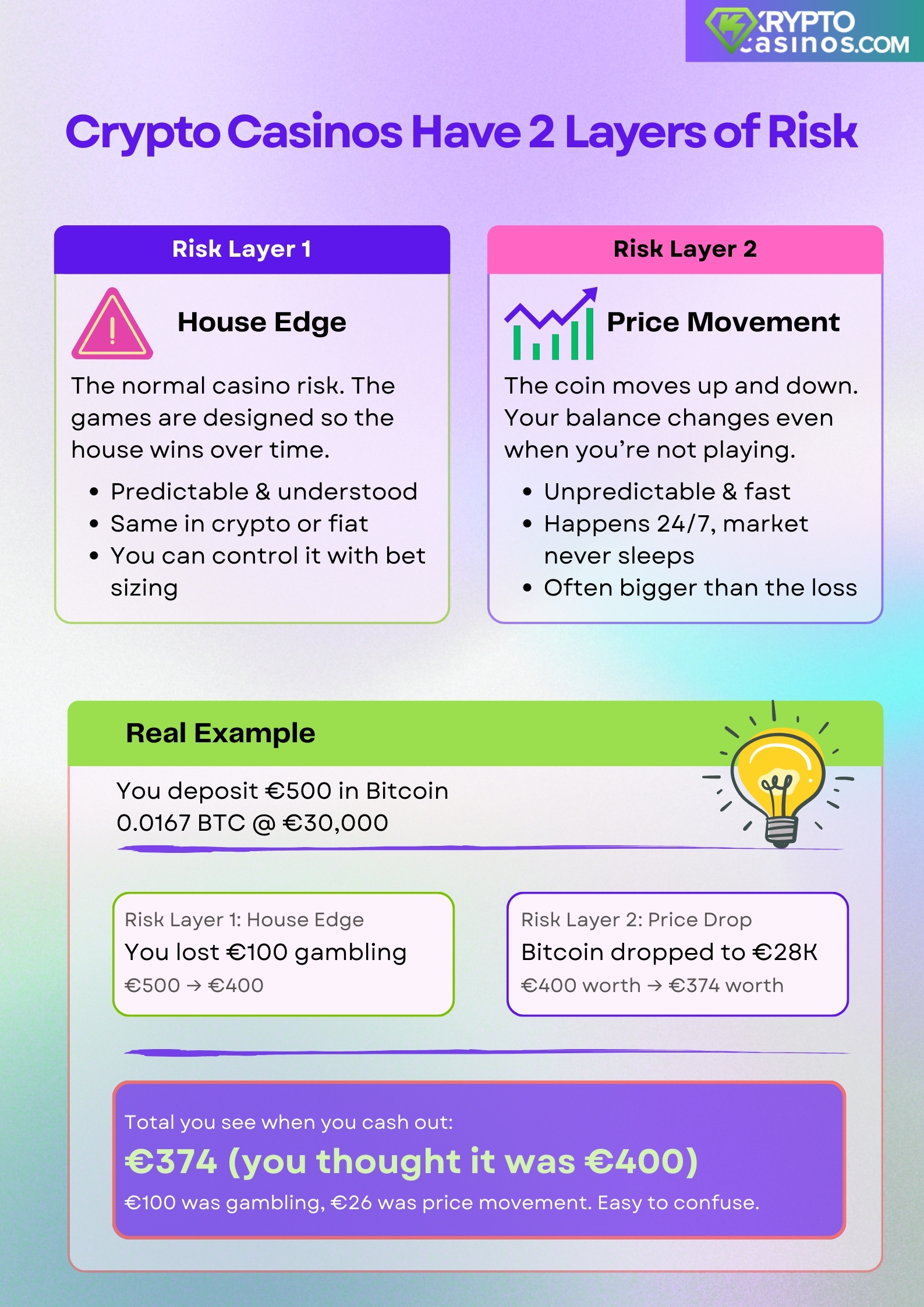
This is a subtle mistake but it's a powerful one. A lot of players confuse the outcome of their gambling with the movement of cryptocurrency prices. And this is important to understand because the two things are totally separate.
Let's make this concrete. You deposit €500 in Bitcoin when it's worth €30,000 per coin. You play for an hour and lose €100 (your balance goes down to €400). But during that hour Bitcoin drops to €28,000. So your €400 is now worth less in euros. When you cash out and convert back, it's worth maybe €375 instead of €400.
The problem with this is that emotionally you'll blame the casino when actually you lost €100 gambling, plus €25 to price movement. These are two different things. But when you see the total loss you might think it was all bad luck at the casino.
The solution is to track them separately. Keep a simple note of your deposits and withdrawals in actual cryptocurrency, not euros. So: “Deposited 0.0167 BTC (€500), withdrew 0.0133 BTC (€400).” That means you lost 0.0034 BTC gambling. That's your actual gambling loss. If that coin moves up or down in price after that, it's just market movement.
Set Your Loss Limit Before You Play
Speed is a feature of crypto casinos (you can deposit and start playing almost instantly). But speed is also a trap. Because deposits are so quick and easy, it becomes too easy to add more money when you're losing. You tell yourself you'll deposit €100, but after that runs out you can fund your account again in 30 seconds. Then again. Then again.
Here's the behavioral part: because deposits are so frictionless, it's too easy to react emotionally. You're on a losing streak and your brain keeps telling you that just one more deposit could turn it around.
And this is why setting your session budget before you play is the simplest and most important approach. Decide in advance: “I can afford to lose €200 this week.” Then put exactly €200 into your casino wallet and commit to stopping there, no matter what. Don't keep your crypto savings in your casino account. Keep the majority in a separate wallet and only transfer what you plan to actually play with.
Keeping your main crypto holdings as well as your casino account separately is honestly the easiest safety tool you have. For example, if your €200 is in the casino itself and you actually want to add more, you’ll need to transfer it from your cold storage. That extra step gives you the ability to pause and think before you top it up.
Using Unlicensed Platforms
The decentralized nature of crypto means basically anyone can claim they're running a casino. And many do, without proper licensing or oversight. The appeal is obvious: they accept players from anywhere, no questions asked. But this convenience has a real cost.
Unregulated platforms often aren't competent at practicing fair play or providing adequate security. You might think blockchain technology and “provably fair” systems take care of this for you. But they don't, completely. If a casino claims provably fair play but doesn't actually allow verification, it can still be rigged.
The practical check is straightforward: the first thing to look for is whether the casino holds a valid license. Look for licenses from places like Curacao, Anjouan or Malta Gaming Authority. A legitimate license means the casino has undergone compliance reviews and has some accountability. It's not perfect, but it's infinitely better than nothing.
Also check independent review sites and user forums for genuine feedback, and avoid sites that make it difficult to reach real humans through customer support.
Takeaway
Crypto casinos come with a second type of risk that doesn't exist in traditional online casinos. Besides the normal game variance there's also an exchange risk from the coin itself. And this means you're dealing with two layers of uncertainty instead of just one.
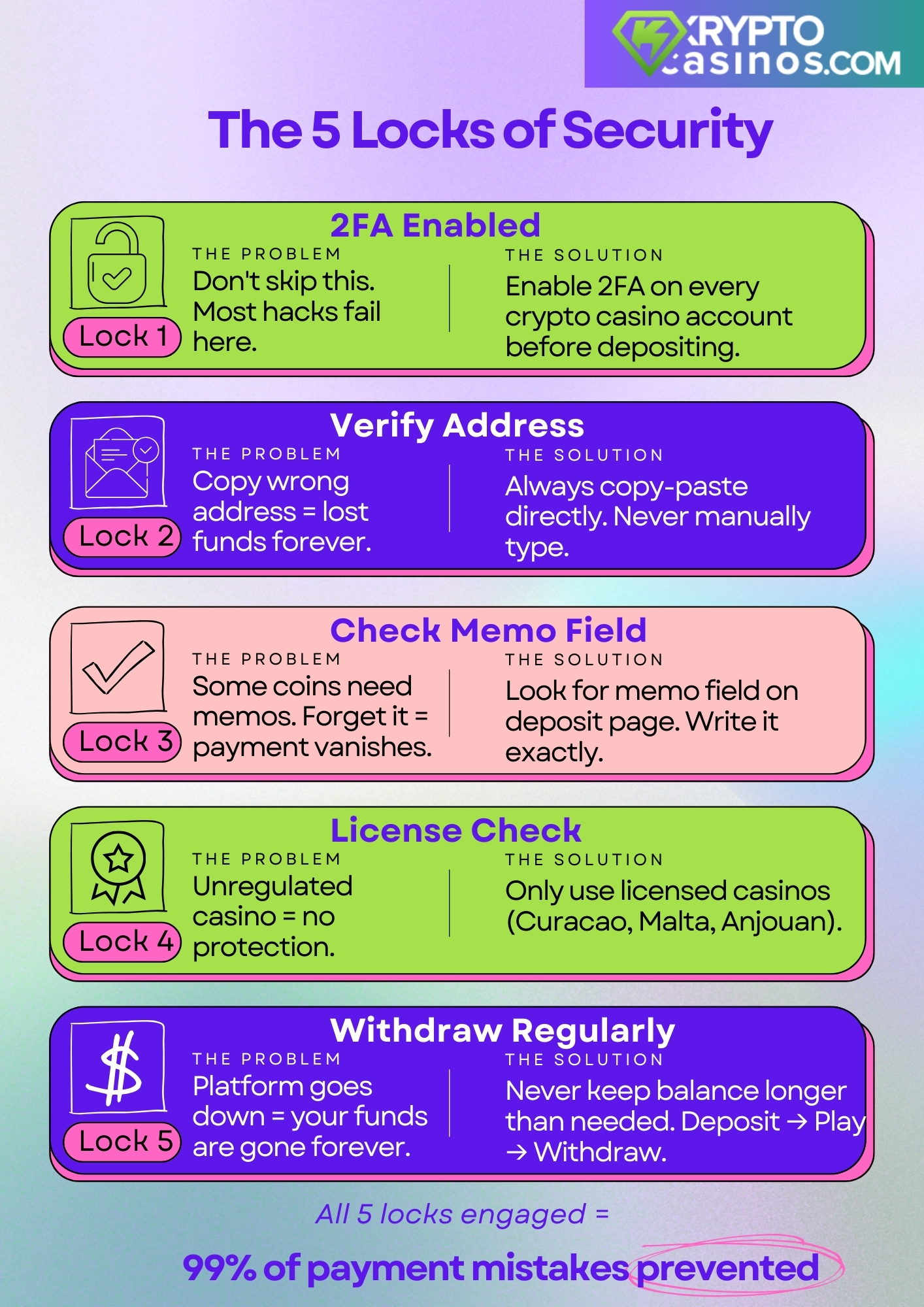
The good news is that most of these risks can be reduced with just simple habits. Enable 2FA, verify addresses before sending, read the fine print on bonuses, track gambling losses separately from price movements, set your budget before you play, use licensed casinos, withdraw regularly, and avoid phishing. These aren't complicated. They're just disciplined.
The most important thing to understand is that crypto price movement is separate from the gambling results. Once you fully understand that distinction, managing payments and avoiding mistakes will become much simpler and easier. The players who keep their funds safe aren't necessarily the ones with the most money or the best luck. They're the ones who treat crypto casino payments like what they actually are: a system where mistakes have real consequences and shortcuts just aren't possible.
Disclaimer: This website is for informational purposes only and does not constitute legal advice. Winnings are not guaranteed. Gambling can be addictive. Only play where legal in your region and check your local laws. Please gamble responsibly. | 18+
Sources
- ACGCS. "The Risks of Online Gambling with Cryptocurrency". Accessed on 03.03.2026. https://www.acgcs.org/articles/the-risks-of-online-gambling-with-cryptocurrency.
- Investopedia. "Cryptocurrency Explained With Pros and Cons for Investment". Accessed on 03.03.2026. https://www.investopedia.com/terms/c/cryptocurrency.asp.