
Provably Fair Gaming and RTP: What Actually Matters (and What Doesn’t)
Provably fair gaming and RTP are oftentimes mentioned together however they solve quite different problems.

 Advertising transparency
 The casino reviews and recommendations on Kryptocasinos.com are independent and transparent. This helps users worldwide make well-informed decisions when choosing the right online crypto casino.
To this end, we research current casino data, process it objectively, and offer users interactive features such as filters and comparison tables. This allows readers to conduct their own research free of charge, compare our content and the casinos, and make their own decisions on this basis.
We may generate revenue when readers register at one of the casinos.
We have imposed strict editorial guidelines on ourselves and explain our testing methods openly and comprehensively. We also communicate transparently how our work is financed. This site may contain tracking links, but this does not influence our objective view in any way.
Reading time: ~ 10 minutes
On one hand, you have RTP which basically defines how much a game will pay you back over the long run; on the other hand you have provably fair which proves that every player/individual's outcome was generated honestly. So in the short term, one is mathematics but the other one is transparency.
It is worth mentioning that provably fair does not actually increase RTP and it doesn't remove the house edge in a way. What it does actually, is that it allows players to verify round by round that the casino itself didn’t manipulate the result after seeing the bet.
In this guide you will learn how provably fair systems work at a cryptographic level as well as how RTP is calculated. Also, where these 2 concepts interfere and where they don't as well as what limitations exist in provably fair games.
RTP is Fixed by Game Mathematics
In simple terms, RTP is the percentage of all wagers that a game is actually returning to players over a large number of rounds. And then, mathematically RTP is calculated by multiplying the probability of each possible outcome by the payout and then summing the results across all outcomes.
The house age is just the remainder – 100% minus the RTP.
Just as an example, let's say that a game has a RTP of 96%. So that would mean that for every $100 played, you would get $96 and the remaining $4 would stay in the casino itself.
It is very important to note that this number isn't really up for discussion and it is not negotiable during your play because it is built into the game's structure and the probability model. And no matter if a certain game is using a traditional RNG or provably fair system really, that makes no difference to RTP.
What often misleads players are the short term results because a few dozen or even a few thousand rounds can’t tell you literally nothing about RTP. You can equally lose heavily on a high RTP game as much as you can win on a low RTP one, because RTP only emerges over very large sample sizes.
And then you have variance which explains how that RTP is experienced. For example, the high variance games pay out less frequently but with larger wins, and on the other hand, you have low variance games which pay smaller amounts but more often. Remember that two games with identical RTP can feel completely different once you start playing.
Finally, provably fair doesn’t change the variance or the RTP; it only proves that randomness feeding into those systems was not tampered with.
What Provably Fair Actually Proves?
Well the traditional online casinos rely on licensing authorities as well as third party testing labs that verify that their RNGs are fair and that games really perform at their stated RTP, and players really trust those licenses. However, provably fair systems replace that sort of blind trust with real verification.
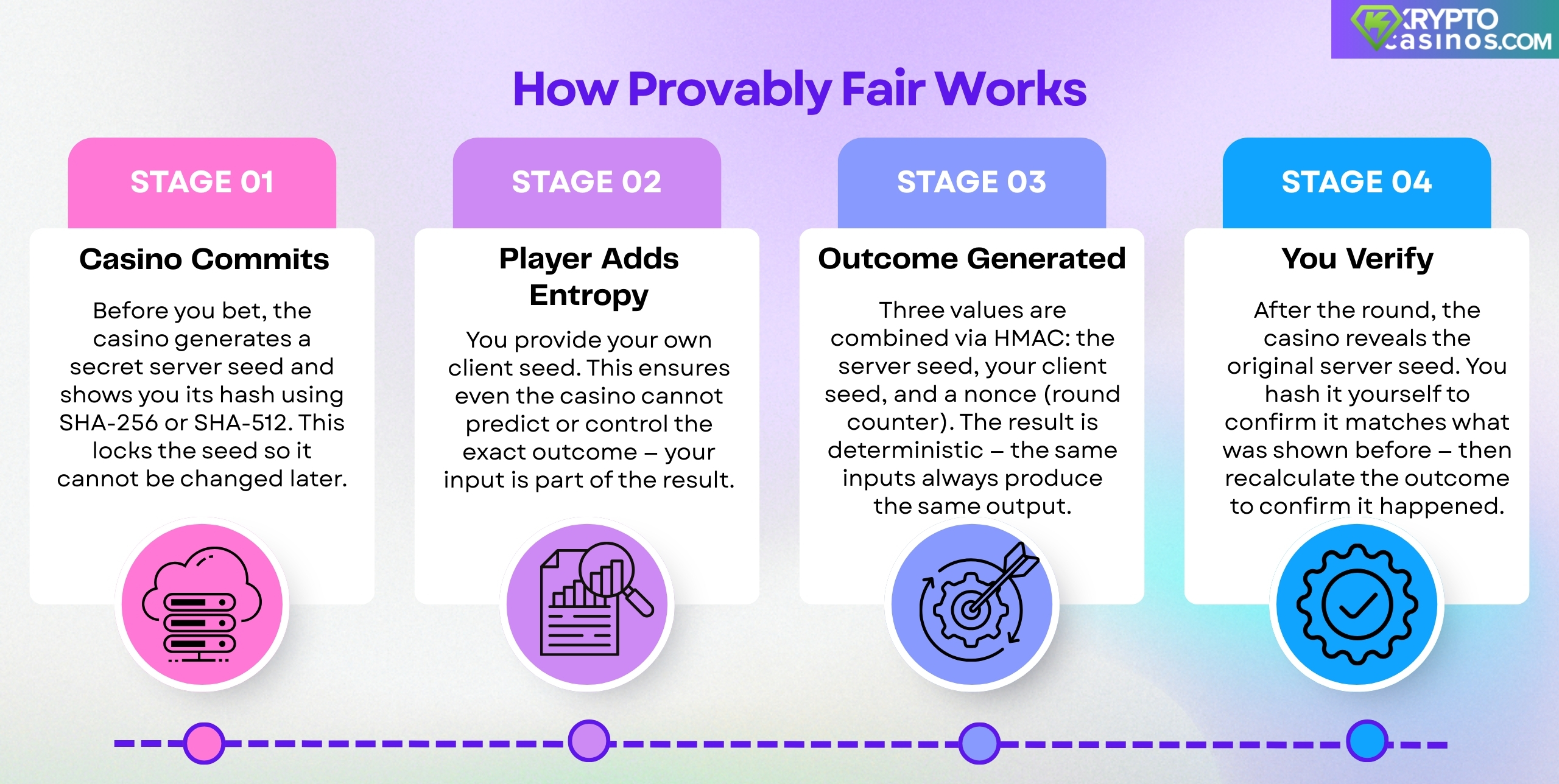
That’s because at the very core of provably fair gaming there is a cryptographic commit and release process. That means before the round is played by a player, the casino generates a secret server seed and immediately hashes it using a hash function like SHA 256 or SHA 512. And that hash is shown to the player before that bet is actually placed.
Since hash functions are one way only the casino itself can’t really alter the server seed later on without breaking the hash; the seed is effectively locked in.
In fact, three numbers are combined when you play a probably fair game, and that is a secret number from the casino itself, a number from you and a counter. And these numbers are run through a mathematical formula that would always produce the same result when the same inputs are used. That result would determine the outcome of that particular round which basically means that the casino can’t really change it afterwards – so you can verify that it was generated fairly.
Then after the round ends the casino would reveal the original secret number it used as well as the round counter. Then you can utilize those numbers to recalculate the result by yourself and check 2 things – that the secret number actually matches the hash that was shown before the game even started and that the recalculated result matches the outcome you have actually received. Then if both checks pass that means that the round was provably fair.
It’s important to remember that the system doesn’t prevent losing but it prevents silent manipulation.
The Cryptographic Building Blocks
Provably fair systems use standard, widely trusted cryptographic methods instead of secret or custom random number systems created only by the casino.
Hash functions such as SHA-256 or SHA-512 are used to commit to server seeds in advance. Once published, the hash locks the seed in place.
HMAC (Hash-based Message Authentication Code) is commonly used to combine seeds securely. In many implementations, the server seed acts as the secret key, while the client seed and nonce form the message. This ensures the output is bound to the committed seed and cannot be altered later.
Seeds play distinct roles. The server seed introduces entropy controlled by the casino, while the client seed introduces entropy controlled by the player. The nonce ensures that each round produces a unique result even when seeds remain the same.
Underneath all of this is still a deterministic algorithm. Given the same inputs, the output will always be identical. Provably fair systems embrace this determinism because it allows verification.
Some newer systems go further by using verifiable random functions or on-chain randomness sources, such as blockchain-based VRFs, which provide both randomness and cryptographic proof that the randomness was generated correctly.
How Players Verify a Round
From a player’s perspective the verification process follows a consistent pattern – before betting the player sees a hash of the server seed and after the round, as we already discussed, the casino reveals the seed, the nonce and the result.
Then the player hashes the revealed server seed and checks if it matches the original commitment, and if it doesn’t the casino definitely changed something.
Afterwards, by using the published algorithm the player recombines the server seed, client seed and nonce. Then the resulting value should actually reproduce the exact same number symbol sequence or multiplier shown in the game. And if the values match then the outcome was generated exactly as promised.
It is possible for this process to be done manually via verification tools that are already provided by the casino or through some third party scripts. And for this particular reason, many provably fair casinos provide built-in verification interfaces.
Dice Games: A Simple Case
Dice games are definitely the easiest provably fair games you can understand.
Usually, the encrypted output is turned into a very simple number between 0 and 99 using a basic math step and then that number is used to decide the final result of the game.
Since the output range is very small the mapping has to be done very carefully in order to avoid any bias.
Because the output range is small, the mapping must be done carefully to avoid bias. If the system is built poorly, for example by using too little data from the hash or applying the math incorrectly, it can slightly distort the probabilities and create small statistical imbalances. And once implemented correctly the dice games are extremely transparent and players can easily recompute results and confirm fairness.
RTP of a dice game can depend entirely on the payout structure and that’s why a perfectly fair dice game can have 100% RTP, but most casinos would introduce a small edge. This means that provably fair has no impact on that particular calculation.
Slots: Where Verification Gets Harder
Slots that are provably fair use the same cryptographic system, but they are harder for players to fully check.
One encrypted result has to be turned into several reel positions, and those positions are then compared to a paytable to calculate winnings.
Players can actually confirm that the reel positions were correctly and fairly generated from the original seeds but they actually aren't really able to confirm whether the reel setup and paytable deliver the RTP that was advertised unless the casino openly shares that information.
In simple terms, provably fair shows that the spin was random, but it does not prove that the slot is generous, and that difference is very important.
Where Provably Fair Falls Short
Provably fair systems can eliminate a lot of classic forms of cheating, however they are not guaranteed in a way. A limitation that we oftentimes see is that provable fairness can only apply to the randomness process and not the game design. That’s because a casino can build a game with a poor RTP or biased structure and still generate the outcomes fairly.
There have been cases where more subtle attacks still exist. For instance, in shuffle based games the initial state matters more than you think. In the case where the starting deck or the reel order are chosen in a very biased way before even shuffling then it is possible the shuffle to be probably fair while favouring the house. Again, these types of issues have been demonstrated in the real world.
But there are some technical risks that you should also keep in mind. And those can be, but not limited to reusing seeds, mishandling nonces, using weak randomness sources, or applying flawed mapping logic. All of these can compromise fairness and the casino security and they still won’t break the cryptography at all.
Another important thing to mention is that provably fair also relies on correct implementation. Rounding errors and bugs for example can also distort the outcome although the cryptographic process is perfectly sound.
And finally, and honestly, the provably fair systems can't really stop a casino from refusing to finish a round or from withholding the payments. Cryptography by itself can definitely prove that a result has been generated correctly, however, in simple terms can't force a company to act honestly in their business operations.
Provably Fair and Regulation
It is quite well known that gambling regulators don't really require any provably fair systems and instead they just require certified RNGs, verified RTP figures and a bunch of financial safeguards.
In a way, provably fair is much more viewed as a transparency enhancement rather than a replacement for regulation. It does allow real time verification, however and most importantly it doesn’t really replace the license itself as well as player protection or dispute resolution mechanisms.
And it is obvious that the strongest trust model would combine both provable randomness and regulation. For a broader evaluation framework beyond randomness and licensing, you should also understand how to check if a crypto casino is legit.
What You Should Take Away
Provably fair gaming gives you the opportunity to take a look as to how outcomes are generated. It totally removes the need to just blindly trust that the casino didn’t manipulate some specific rounds. It definitely can’t and doesn’t improve odds nor it changes the RTP, that’s what you need to understand. And players like you should definitely use certain verification tools occasionally and understand that fairness isn't really the same as favorability.
Also: RTP still governs the long term outcomes; variance defines risk and it’s of a paramount meaning for you to understand that provably fair simply ensures that losses and wins happen honestly.
Final Thoughts
In simple words, provably fair gaming replaces the – trust us with verify us yourself, and this is a very meaningful shift in terms of transparency across online gambling. Again, cryptography can't really override maths because the house edge still remains and regulation matters a lot.
Used properly, provably fair systems empower players with proof, not promises. And in an industry built on trust, that proof is all that really matters.
Disclaimer: This website is for informational purposes only and does not constitute legal advice. Winnings are not guaranteed. Gambling can be addictive. Only play where legal in your region and check your local laws. Please gamble responsibly. | 18+
Sources
- SOFTSWISS. "Provably Fair in Gambling: Algorithms Explained". Accessed on 23.02.2026. https://www.softswiss.com/knowledge-base/provably-fair-igaming/.
- Gambling Commission. "RTP games". Accessed on 23.02.2026. https://www.gamblingcommission.gov.uk/about-us/freedomofinformation/rtp-games.