
Provably Fair vs RTP: Key Differences
Although provably fair and RTP are oftentimes mentioned together, it’s important to understand that they solve different problems.

 Advertising transparency
 The casino reviews and recommendations on Kryptocasinos.com are independent and transparent. This helps users worldwide make well-informed decisions when choosing the right online crypto casino.
To this end, we research current casino data, process it objectively, and offer users interactive features such as filters and comparison tables. This allows readers to conduct their own research free of charge, compare our content and the casinos, and make their own decisions on this basis.
We may generate revenue when readers register at one of the casinos.
We have imposed strict editorial guidelines on ourselves and explain our testing methods openly and comprehensively. We also communicate transparently how our work is financed. This site may contain tracking links, but this does not influence our objective view in any way.
Reading time: ~ 7 minutes
RTP is a mathematical model built into the game design and it tells you how much a game will pay you over time. On the other hand, probably fair gives you the opportunity to verify that the round was generated in an honest way. In a way, one focuses on long term returns while the other on transparency.
It’s worth noting that provably fair doesn’t increase RTP in any way and it doesn’t remove the house edge, but what it does it simply allows you and other players to verify that the casino didn’t manipulate a specific result after a certain bet was placed. Games that are based on RTP rely strictly on regulators and statistical monitoring to make sure that there is fairness present. This means that both systems can be fair, they just approach fairness in very different ways.
Trust Model
In a regular traditional RTP model most of the players would just trust regulators as well as certification labs where the game developers only submit the RNG systems and payout math for testing. And then if it’s approved the game is licensed with a certified RTP percentage. In this case, players aren’t able to verify the individual spins, they only trust the system because it has already been verified.
That structure is being changed by provably fair. Before a round even starts, the casino commits to a secret server seed by publishing its hash and then the player provides a client seed. Afterwards, the result is calculated from these combined inputs. Then after the round, the server seed is revealed and the player can verify that the hash machines and the outcome are not changed. So basically, instead of trusting an authority, players can check the match themselves. And that trust shifts from institutions to cryptography.
Instead of trusting an authority, the player can check the math themselves. The trust shifts from institutions to cryptography.
Transparency and Auditability
In a way, the provably fair systems are being transparent by design where each round has a visible commitment, a reveal + the verification step. This is good because many crypto casinos are including built in verification tools so players can check their results quickly and instantly, and some of them even make their algorithms available to the public.
Compared to provably fair, the RTP systems are not that much transparent when you think about it. That is because you and other players would only see the RTP that is advertised but you have no clue about the internal RNG process.
Or, in simple terms RTP offers regulator facing transparency while provably fair offers player facing transparency.
Time Scale of Fairness
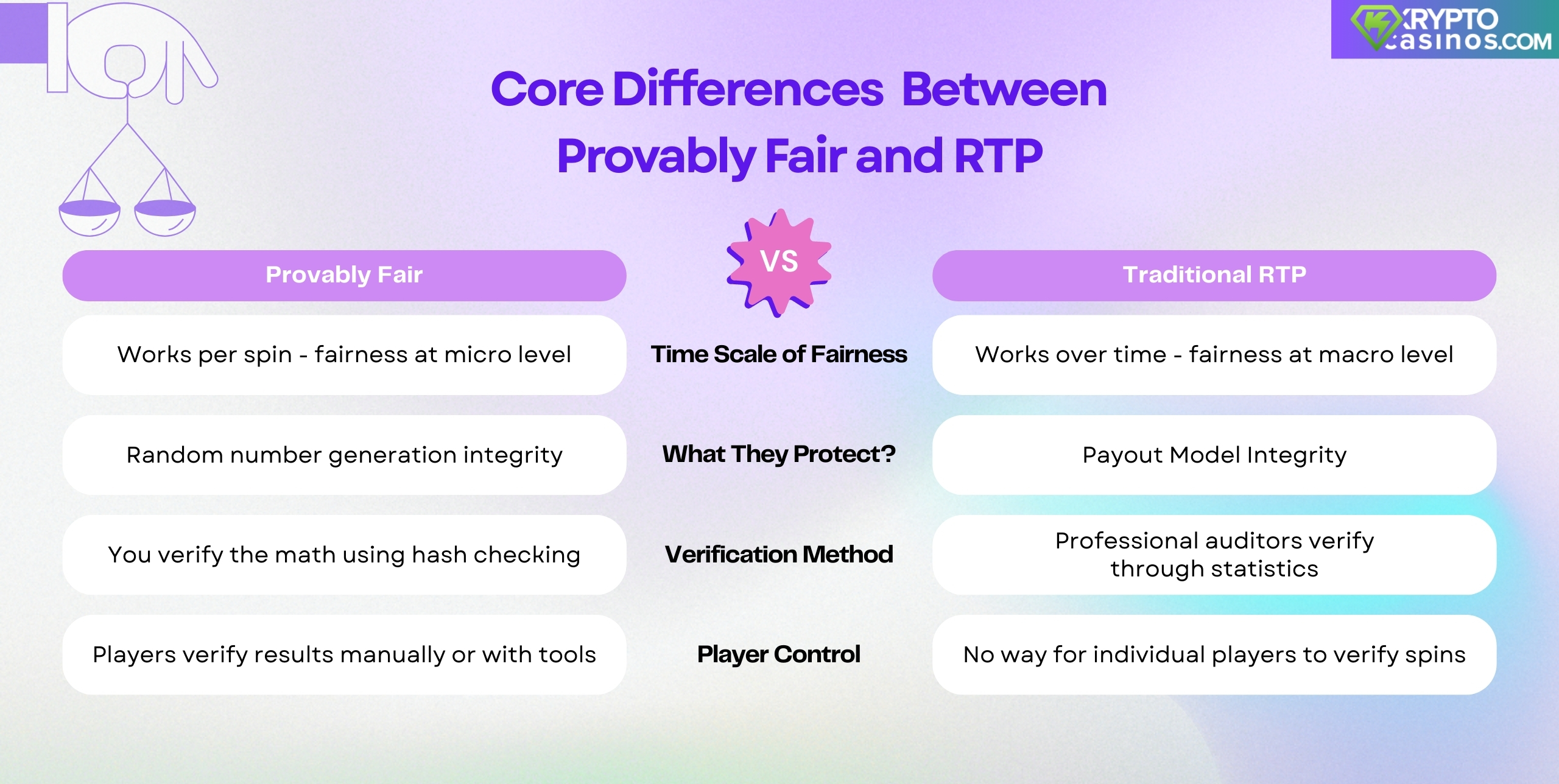
Since we are talking about the differences it is worth mentioning that this one is one of the most important ones. That’s because provably fair works per spin and each individual can be verified and audited immediately. If the spin result won’t match the committed hash the issue would be so obvious.
On the other hand, RTP works over time. Take this as an example – an online slot with 96% RTP won’t really guarantee you 96 back from your sessions. That means that across a great amount of spin the average payout can only approach 96% and short term results can really vary a lot.
Then you have provably fair which guarantees honest randomness for each round; RTP just guarantees statistical fairness across many many rounds.
Player Control and Verification
In games that are provably fair, the players themselves are part of this randomness process and that’s because they can often set or change their client seed. Then after every round they can verify the outcome manually or with some sort of automated tool.
On the other hand, with RTP games players just spin and can only hope since they have no control over the seed nor a visibility into the RNG, basically they have no ability to validate one single spin.
The verification in the RTP systems requires large amounts of data sets as well as professional audits, while verification in provably fair can happen immediately after each single bet.
Operator Incentives and Manipulation Risk
It’s important to note that both of these systems are built in a way where the casino will make money over time. However, more importantly, there is a difference as to how the manipulation would be detected.
With provably fair games, the casino commits to the result first, and only reveals it later. Because of that, it cannot go back and change the outcome after seeing your bet. But in the case if it does, the mismatch would be very visible and that makes the manipulation extremely different in a way.
While in traditional systems, that manipulation can be only detected through audits as well as statistical monitoring. The regulators only compare actual payout data against the theoretical RTP and what would raise red flags are the large deviations.
Anyways, none of these systems can eliminate the house edge at all. They both rely on game mathematics for profit. Provably fair protects the integrity of the random generation process, whereas RTP protects the integrity of the payout model.
Regulatory Status
RTP compliance is definitely needed in the regulated gambling markets which is why most jurisdictions ask for a minimum RTP levels as well as third party RNG testing with ongoing monitoring.
What’s optional in this case is the provably fair system. It’s much more common in crypto casinos and it’s seen as an extra layer of transparency feature rather than a regulatory requirement.
However, even the provably fair casinos have to comply with gambling laws and include KYC, AML as well as responsible gambling standards where possible and applicable.
User Experience
Provably fair games are much more prominent in the crypto sphere because many of these platforms have interfaces that are much simpler and focused on dice, crash games or minimalist slots. On the other hand, the traditional RTP games focus mostly on interesting and immersive design, animations and familiarity. It’s crucial to know that these fairness mechanisms operate behind the scenes in order for the experience to feel seamless.
And many players would honestly see provable fairness as reassuring, however it is not that often used in practice, they just like that the feature only exists, but they wouldn't check a single hash.
Statistical Variance
Provably fair doesn’t really reduce the volatility and a provably fair slot can still produce long losing streaks. The thing is, that the randomness is not softened, it’s simply just verified.
Additionally, we have the presence of RTP, which is a long term metric that's applicable to both of these systems. This is because even in a provably fair game, a large sample size is required to see any results.
Responsible Gambling
As we discussed before, you and other players might feel more confident in a provably fair game because you can verify the results yourself, however please note that those games can also cause rapid losses because they are simply not harmless. Transparency does not prevent harm. A provably fair game can still cause rapid losses.
And both of these models still do require responsible gambling tools like deposit limits, self exclusion systems etc, because fairness alone isn’t really a safety mechanism.
Comparison Table
| Attribute | Provably Fair | Traditional RTP |
|---|---|---|
| Trust Model | Cryptographic verification by player | Trust in regulators and audits |
| Transparency | Public seed and hash checks per round | Aggregate RTP data and lab certification |
| Fairness Timing | Verified each spin | Verified statistically over time |
| Player Role | Can input seeds and verify outcomes | No control over RNG process |
| Manipulation Detection | Hash mismatch exposes tampering | Audits and statistical monitoring detect issues |
| Regulatory Position | Optional transparency feature | Mandatory compliance standard |
| Variance | Unchanged, randomness per spin | Unchanged, long term convergence |
| Responsible Gambling | Requires external controls | Requires external controls |
Final Takeaway
It’s important to understand that provably fair and RTP are not competitors, they just operate on different layers. On the one hand there’s RTP which defines the economic structure of the game in a way, it also determines the long term return.
On the other hand, there’s provably fair system that verifies that each round is following certain rules honestly. There is a possibility for a certain game to have high RTP but no provable fairness and also, a game can be provably fair but can still have low RTP. It is ideal for you to take a look at both.
Disclaimer: This website is for informational purposes only and does not constitute legal advice. Winnings are not guaranteed. Gambling can be addictive. Only play where legal in your region and check your local laws. Please gamble responsibly. | 18+
Sources
- SOFTSWISS. "Provably Fair in Gambling: Algorithms Explained". Accessed on 24.02.2026. https://www.softswiss.com/knowledge-base/provably-fair-igaming/.
- Gambling Commission. "How to calculate return to player (RTP)". Accessed on 24.02.2026. https://www.gamblingcommission.gov.uk/licensees-and-businesses/guide/page/how-to-calculate-return-to-player-rtp.
- SSRN. "The Online Gambling Fairness Paradox: Cryptographic Verification, Behavioral Harm, and Consumer Protection". Accessed on 24.02.2026. https://papers.ssrn.com/sol3/papers.cfm?abstract_id=6065213.