
Risks of VPN Use at Crypto Casinos

 Advertising transparency
 The casino reviews and recommendations on Kryptocasinos.com are independent and transparent. This helps users worldwide make well-informed decisions when choosing the right online crypto casino.
To this end, we research current casino data, process it objectively, and offer users interactive features such as filters and comparison tables. This allows readers to conduct their own research free of charge, compare our content and the casinos, and make their own decisions on this basis.
We may generate revenue when readers register at one of the casinos.
This website is for informational purposes only and does not constitute legal advice. Winnings are not guaranteed. Gambling can be addictive. Only play where legal in your region and check your local laws. Please gamble responsibly. | 18+
For many players, using a VPN is completely unrelated to gambling. It’s just something running in the background for general privacy and is nothing too dramatic.
But for crypto casinos, VPNs can become a big deal, especially at withdrawals. This page exists because these topics appear together very often, but the risks and trade-offs are never explained. We’ll look at why VPNs can sometimes turn into a bigger issue later.
Why VPNs Come Up in Crypto Casinos
Crypto casinos are entirely online, with no physical location, no and no cashier where you deposit. Everything happens through a web browser or a mobile app.
The fact that you can deposit from anywhere, play from anywhere, and access the site as you please, can might make you think that location is not important to online gambling.
But here’s a fact many players don’t think about at first: casinos still operate under licenses. And those licenses still depend on rules and regulations.
So, because of the rules of the jurisdictions they operate under, casinos still need to know where players connect from. And they still need to run fraud prevention and security checks.
Even though a VPN might not seem like a big deal to you, for some casinos, it looks like a red flag that needs to be checked.
VPNs and Casino Terms and Conditions
The reality is that many casino players never actually read the terms and conditions; some who do read them don't read them fully.
You usually sign up, deposit, play a bit, and only when something goes wrong, you might remember to read the actual terms. And there, you would be surprised at how many casinos restrict or prohibit VPN use.
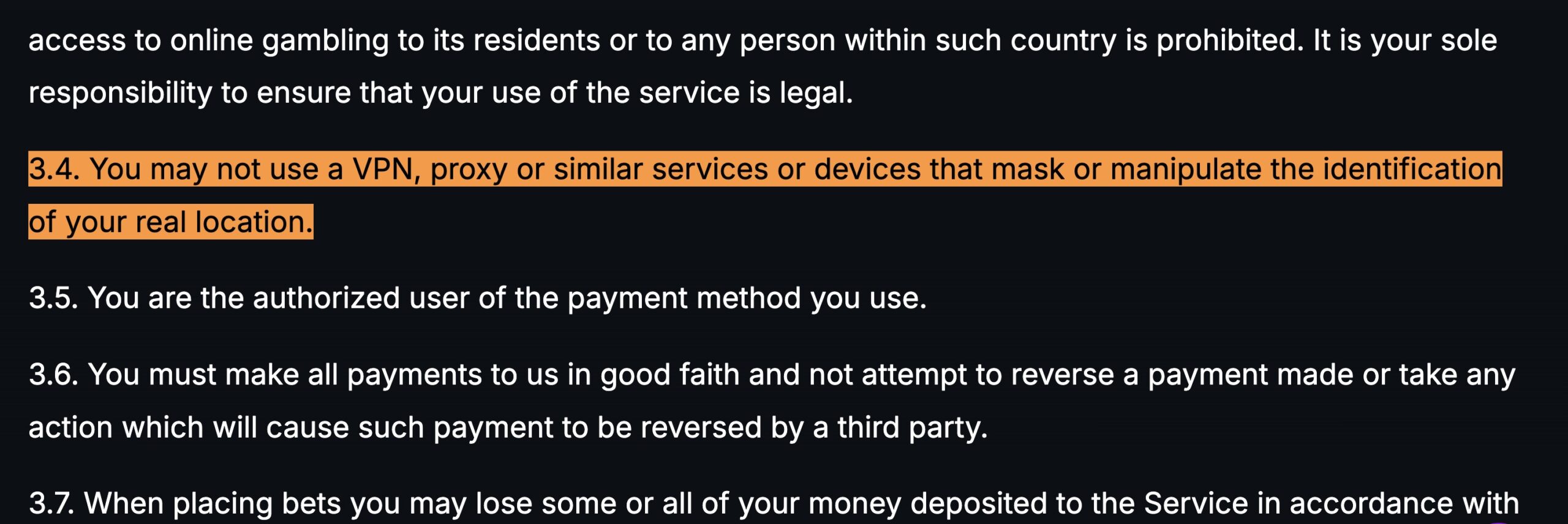
Reading clauses like this after creating an account and playing for some time often feels confusing because the experience up until that moment may have been very normal.
From your perspective, using a VPN for your own privacy feels completely unrelated to gambling, but from the casino’s end, it might look like you're masking your own location.
And this difference in between player's and casino's perspective is exactly where problems with VPN and crypto casinos start.
Why VPN Use Can Affect Withdrawals
There's one misconception about crypto casinos that must be mentioned here, most sites will allow you to play with a VPN running in the background. Nothing will be blocked or restricted at first.
But wait until withdrawals come, and suddenly using a VPN might turn out to be a problem, which is why VPN use often appears in complaints about withdrawal delays and reviews.
Withdrawals are the point where the casino checks things like your login history, IPs, devices you used, on top of general account behavior.
And if anything looks weird, they have to stop everything and ask questions before money can be released.
Those questions might be additional identity verification requests or manual security checks, and this will most definitely affect your withdrawals.
This delay from your side may seem sudden, but on the casino's side, these checks are happening at the exact moment they always happen: before payouts.
Legal and Regulatory Uncertainty
Another layer that makes this whole topic is the legal side. Considering that gambling laws are location-specific, what is fine for one region may not be for another.
So even if a crypto casino suggests they are accessible from anywhere, they can't operate “worldwide” in a legal sense, because they operate under a license.
And that license comes from a specific jurisdiction, and each has its own rules, restrictions and obligations the license holder must follow so they keep operating.
This means that the casino must be able to show regulators that players are not accessing the site from restricted locations, that it has AML (anti-money laundering) checks in place, and that its location and identity verification systems work.
If they fail to do any of this, the regulator can fine them and even cancel their right to operate.
So, when VPNs enter the picture, the situation becomes even less clear. What country is the player actually in? Which laws apply there? Can it process a payout under the license if the real location is not known?
When anything like this happens, casinos tend to choose the safer option from their side, which usually means additional checks, delayed withdrawals, and sometimes even suspended accounts.
Privacy vs Account Security: The Trade-Off
Public Wi-Fis aren’t exactly known for being safe, which is why many crypto users run VPNs as an extra step when protecting crypto wallets when accessing sites from public networks.
But crypto casinos have a different set of priorities compared to players. They spend a lot of time trying to detect fraud, multiple accounts, and bonus abuse. Their security systems can notice anything that doesn't look consistent. And consistency is what VPNs disrupt.
From their side, an unusual connection can look very similar to fraud. From your side, it might just be a privacy tool quietly running in the background that you don’t even think about anymore.
Neither side is really wrong. They just look at the same thing through different perspectives.
VPN Uses That Raise Red Flags
Nobody really knows the exact rules casinos follow internally, as they don’t publish these publicly. And even if they did, they’d likely change them all the time.
But if you read enough player complaints and community conversations, the same patterns keep showing up again and again.
Things like having Portugal in your ID and then logging in from servers in Singapore, or playing normally for weeks and then suddenly connecting via VPN right when requesting a payout.
None of these automatically mean something is wrong. People travel, change devices, and internet connections change all the time. Real life is messy.
But the casino's automated fraud systems don’t see context; they see patterns. And once an account falls into the “needs review” category, things usually slow down.
How This Fits Into Other Security Risks
Issues with VPN use don’t exist in isolation. They connect to many other security risks in crypto casinos.
We already mentioned issues during withdrawals, but the connection often starts earlier than that. Players who use VPNs are often the same players who worry about things like:
- Detecting crypto casino scams, learning about fake casinos, impersonation, and misleading bonus offers
- Wallet security, protecting funds and private keys from loss or theft
- Phishing and fake support, recognizing account takeover risks
Most security topics in crypto casinos overlap in some way, and VPNs are just one part of the whole story.
Conclusion
VPNs aren’t automatically a problem. However, they do add one more layer of uncertainty to something that already has a lot of moving parts.
In many cases, nothing bad happens when using VPNs. But in some cases, extra checks appear later, usually right around the time of withdrawals.
Feeling safe online matters, but so does avoiding surprises when it’s time to cash out, which is you need to know how VPNs fit into the crypto casinos picture.
We have imposed strict editorial guidelines on ourselves and explain our testing methods openly and comprehensively. We also communicate transparently how our work is financed. This site may contain tracking links, but this does not influence our objective view in any way.
More pages